
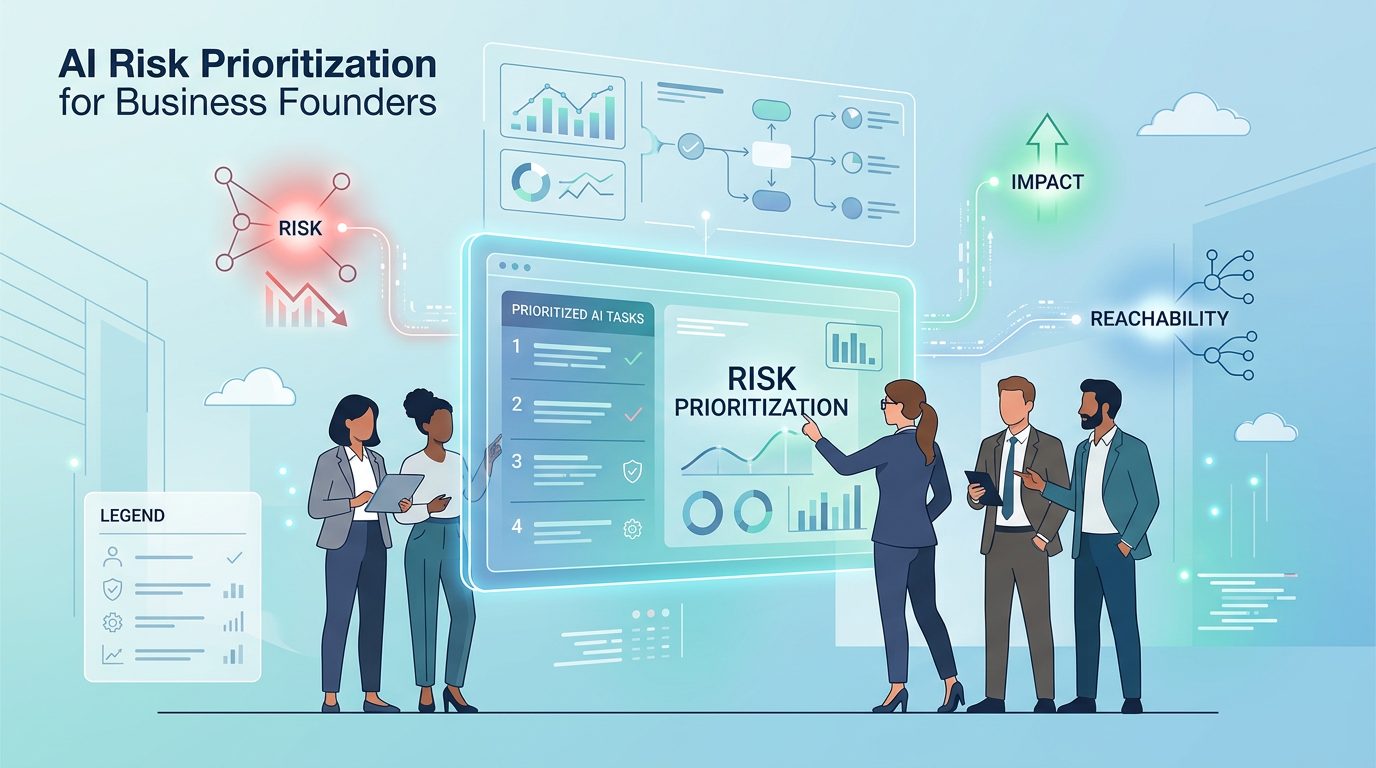
AI Risk Prioritization: How Founders Should Choose What to Automate First
AI risk prioritization is becoming a practical operating discipline for founders, agencies, and growing teams. The question is no longer whether AI can automate work. It can. The harder question is which workflows actually deserve attention first, which ones create meaningful business exposure, and which ones are just noise disguised as urgency.
Many businesses are approaching AI automation the same way overloaded security teams approach vulnerability backlogs: everything looks important, every tool produces more alerts, and every department wants its problem solved first. But speed alone does not solve a prioritization problem. Without context, faster automation can simply create faster confusion.
Key Takeaways
- Not every manual process is worth automating immediately.
- The best AI opportunities sit where operational friction, business impact, and repeatability overlap.
- Founders should evaluate AI projects by reachability, risk, and revenue impact, not by novelty.
- AI systems need compensating controls when full automation is not safe or practical.
- Agencies can help businesses move from AI experiments to structured operating systems.
The Real Problem Is Not a Lack of AI Ideas
Most founders do not suffer from a shortage of AI use cases. They have the opposite problem. Their teams can identify dozens of possible automations: lead qualification, customer support, proposal writing, onboarding, invoice follow-up, reporting, hiring workflows, content operations, internal knowledge search, and more.
The issue is that these ideas often arrive without a decision framework. A founder hears that customer support can be automated, sales wants an AI assistant, operations wants dashboards, marketing wants content workflows, and finance wants reconciliation support. Suddenly, AI implementation becomes a queue of disconnected requests.
This is where AI risk prioritization matters. It forces the business to ask better questions before buying tools or building workflows.
Instead of asking, can we automate this, ask:
- Does this workflow directly affect revenue, customer experience, compliance, or team capacity?
- Is the current process slow because it is repetitive, or because it requires judgment?
- What happens if the AI output is wrong?
- Can a human review step reduce the risk?
- Will this automation connect to the systems the team already uses?
These questions turn AI from a technology project into an operating decision.
From Automation Volume to Business Exposure
A common mistake is treating AI implementation as a volume problem. The assumption is simple: the more workflows we automate, the more efficient the business becomes. That is not always true.
A low-impact automation may save a few minutes per week but create new review work, tool complexity, or data quality issues. A high-impact automation may remove hours of bottleneck time, reduce customer delays, or give leadership a clearer view of risk.
Consider two examples.
Example one: a marketing team automates social media caption drafts. This may be useful, but if the approval process is still slow and content strategy is unclear, the business gains limited leverage.
Example two: a service business automates intake, qualification, routing, and follow-up for inbound leads. If leads were previously sitting unanswered for 24 hours, this workflow may directly improve conversion, reduce admin work, and create cleaner sales reporting.
Both use AI. Only one may change business outcomes quickly.
AI risk prioritization helps teams separate interesting automations from operationally important ones.
The Three Questions Founders Should Ask Before Automating
For business owners, the strongest AI implementation plans usually start with three practical questions.
1. Which workflows can actually be reached by AI?
Some workflows look easy to automate from the outside but are buried inside messy systems, inconsistent data, or undocumented processes. If the AI cannot access the right inputs, or if the team cannot define the desired output, automation will struggle.
For example, an agency may want AI to generate client performance summaries. But if campaign data lives across Google Ads, Meta, HubSpot, spreadsheets, and Slack updates, the first project may not be AI writing. It may be data consolidation and reporting architecture.
Reachability matters. The best first automations usually involve structured inputs, repeatable actions, and clear success criteria.
2. What happens when AI cannot fully solve the problem?
Not every process should be fully automated. In many cases, the right answer is assisted automation. That means AI prepares, recommends, drafts, classifies, or flags the work while a human makes the final decision.
This is especially important in workflows involving pricing, legal language, hiring decisions, financial approvals, customer complaints, or sensitive client communication. The goal is not to remove judgment. The goal is to remove unnecessary drag around judgment.
For instance, an AI system can review customer support tickets, detect urgency, suggest replies, and route issues to the right team. But high-risk complaints or refund requests may still require human approval. That is not a failure of automation. That is good system design.
3. How do we explain this system in a leadership meeting?
Founders need more than dashboards filled with activity. They need specifics. Which workflow was improved? What risk was reduced? What time was saved? What revenue process became more reliable? What decisions are now faster?
A useful AI system should make the business easier to explain, not harder. If leadership cannot understand where AI is active, what it touches, and how performance is measured, the system is not mature enough.
Why Severity Scores Do Not Work for AI Projects
Many teams prioritize AI projects based on urgency from the loudest department. Sales needs help now. Marketing is overloaded. Support is buried. Operations is tired of manual reporting. Every request can sound critical.
But urgency is not the same as business impact.
A better model is to score AI opportunities across four factors:
- Business impact: Does this affect revenue, retention, cost, speed, or quality?
- Process maturity: Is the workflow documented and consistent enough to automate?
- Data readiness: Are the required inputs accessible, clean, and reliable?
- Risk level: What is the downside if the AI makes a mistake?
This creates a more balanced roadmap. A workflow with moderate effort and high business impact may be a better first project than a flashy automation with unclear value. Likewise, a high-risk workflow may still be worth pursuing, but only with human review, audit trails, and limited AI permissions.
Practical AI Prioritization Examples
Here are a few examples of how founders can apply this thinking.
- Lead management: If leads are falling through the cracks, prioritize AI-assisted lead capture, enrichment, routing, and follow-up before experimenting with advanced sales coaching bots.
- Client reporting: If account managers spend hours building updates manually, prioritize data collection and AI-generated first drafts, with human review before delivery.
- Customer support: If the team is overwhelmed by repetitive tickets, prioritize classification, suggested responses, and escalation rules instead of full chatbot replacement.
- Internal knowledge: If employees constantly ask the same operational questions, prioritize a searchable AI knowledge base connected to approved documentation.
- Finance operations: If invoice follow-up is inconsistent, prioritize automated reminders and exception alerts rather than complex forecasting models.
In each case, the goal is not to automate everything. The goal is to identify the small percentage of workflows that create the largest operational gain.
Build Controls Before Scale
AI systems need operating controls, especially when they touch customers, money, data, or brand reputation. A simple AI workflow can become risky if no one knows who owns it, how it is monitored, or when a human should intervene.
Before scaling AI across the business, founders should define:
- Who owns each AI workflow
- What data the system can access
- Which outputs require human approval
- How errors are reported and corrected
- What metrics determine success
- When the workflow should be paused or revised
This is where many AI initiatives break down. The pilot works, but the operating model is missing. The team adds tools but not governance. Workflows become harder to trust because no one is responsible for maintaining them.
How Prime Solution Media Helps Businesses Prioritize AI
Prime Solution Media helps founders and business teams turn AI interest into practical systems. That means looking beyond tool selection and focusing on workflows, bottlenecks, data readiness, and implementation priorities.
For many businesses, the first step is not building a complex AI agent. It is mapping the current operation, identifying where manual work creates measurable drag, and designing an AI-assisted workflow that improves speed without adding unnecessary risk.
Our approach is intentionally practical: define the business problem, assess the workflow, choose the right level of automation, build with review points, and measure the result. This helps teams avoid random AI experiments and move toward systems that support growth.
Conclusion: Better Questions Create Better AI Systems
The next phase of AI adoption will not be won by businesses that automate the most tasks. It will be won by teams that know which tasks matter, which systems are ready, and which risks need controls before scale.
AI risk prioritization gives founders a clearer way to make those decisions. It shifts the conversation from speed to context, from tool adoption to operational improvement, and from scattered experiments to durable business systems.
If your team is looking at a long list of possible AI projects, do not start with the loudest request or the newest tool. Start with the workflow that is reachable, repeatable, measurable, and tied to a real business outcome. That is where AI starts becoming an operating advantage.




