
AI Implementation Services: How Founders Turn AI Tools Into Operating Systems
AI implementation services are becoming more valuable than AI tools themselves. For business owners, the problem is no longer access to powerful models. The problem is knowing where those models belong inside the business, how they connect to existing workflows, and how they create measurable outcomes without creating more operational noise.
Many founders have already tested AI for writing, research, customer support, sales follow-up, or internal reporting. The early experiments are useful, but they rarely change the economics of the company. That change happens when AI is implemented into the operating system of the business.
Key Takeaways
- Most companies do not need more AI software first. They need better workflow design.
- AI creates ROI when it is connected to bottlenecks, data, approvals, and team behavior.
- The highest-value work is mapping operations before building automations.
- Founders should prioritize AI implementation services around revenue, margin, speed, or customer experience.
- A strong implementation partner should build systems, not just recommend tools.
The Shift From AI Access to AI Implementation
For the last few years, the market has treated AI as a tool race. Which model is better? Which chatbot has the newest feature? Which SaaS product added an AI button this month?
That phase matters, but it is not where most businesses get stuck. A $5M service company, a growing ecommerce brand, a regional agency, and a mid-market B2B company usually have the same operational issue: the work is scattered across too many people, spreadsheets, inboxes, CRMs, documents, and informal rules.
AI does not automatically fix that. In many cases, it exposes the mess faster.
If customer data lives in HubSpot, fulfillment details live in Airtable, finance tracks profitability in spreadsheets, and account managers keep key context in Slack, adding another AI tool can make the stack feel more modern while leaving the business just as fragmented.
This is why AI implementation services are becoming a serious business capability. The value is not just in prompting a model. It is in translating AI capability into workflows that improve how the company actually runs.
Why More AI Tools Usually Do Not Solve the Real Problem
Founders often ask which AI tool they should buy. A better first question is: which business constraint are we trying to remove?
Without that clarity, teams end up with tool sprawl. Marketing uses one AI platform. Sales uses another. Operations experiments with automations. Leadership asks for dashboards. No one owns the end-to-end system.
The result is familiar:
- AI pilots that never become daily workflows.
- Automations that break because the underlying data is inconsistent.
- Teams that do not trust outputs because no review process exists.
- Leadership that cannot connect AI activity to profit, retention, or speed.
- Employees who feel AI is being added on top of their work instead of removing friction.
The issue is not that the tools are weak. The issue is that implementation has been treated as a technical add-on rather than an operating discipline.
What Real AI Implementation Looks Like
Effective AI implementation starts before anyone builds an automation. The first step is operational mapping.
This means documenting how work moves through the business today. Not how leadership thinks it moves. Not how the SOP says it moves. How it actually moves from request to decision to delivery.
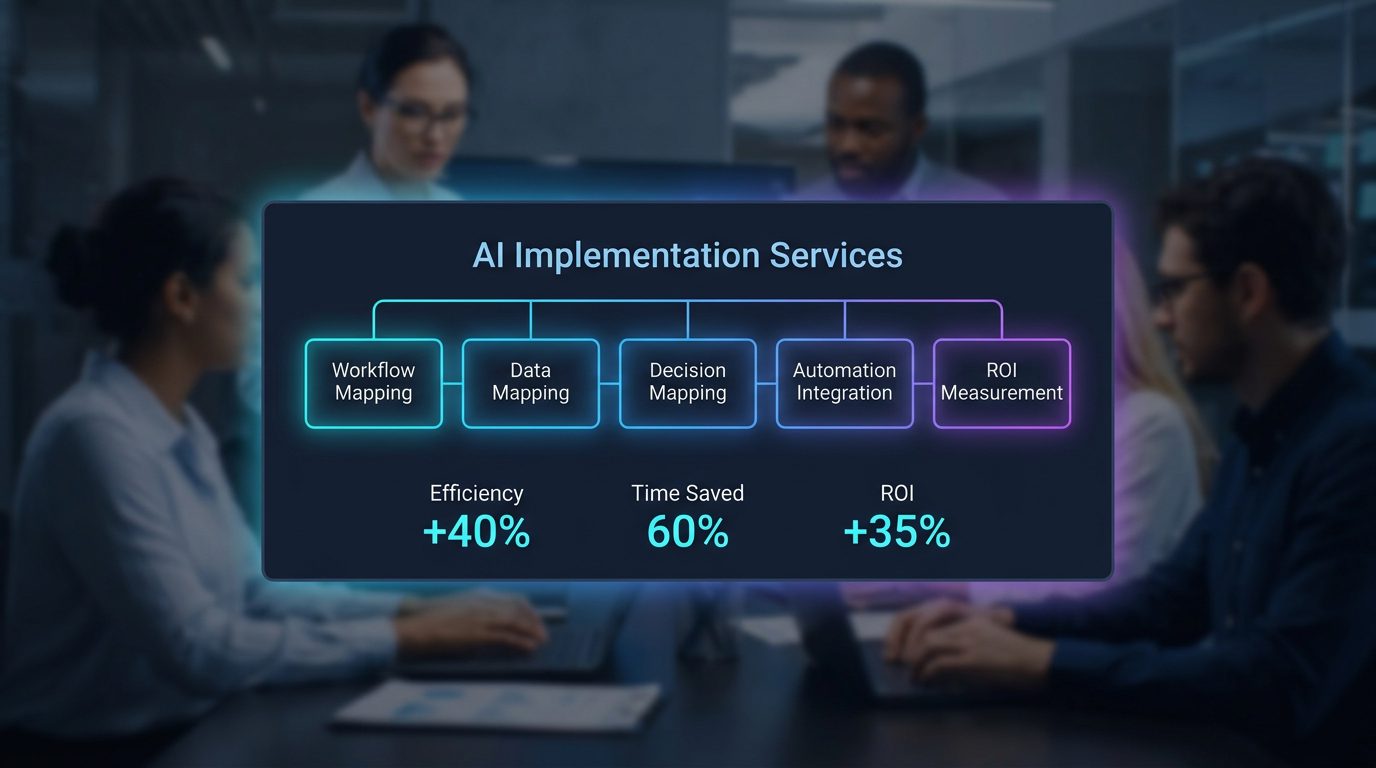
A good implementation process usually includes four layers:
- Workflow mapping: Where does the process start, who touches it, what systems are involved, and where does it slow down?
- Data mapping: What information does the workflow depend on, where does that information live, and how reliable is it?
- Decision mapping: Which decisions are repetitive, which require judgment, and which require human approval?
- ROI mapping: What metric should improve if the system works: time saved, conversion rate, response time, margin, accuracy, or capacity?
Only after that should a business decide whether it needs an AI agent, an automated workflow, a custom internal tool, a CRM cleanup, a knowledge base, or a human-in-the-loop review system.
Practical Examples for Business Owners
Example 1: Sales Follow-Up
A founder may want AI to write follow-up emails. That is useful, but it is a narrow use case. A better implementation would connect lead source, sales notes, call transcripts, CRM stage, proposal status, and next-best action.
Instead of asking a rep to remember every follow-up, the system can summarize the conversation, identify objections, draft a relevant message, update the CRM, and notify the rep when a deal is at risk. The business outcome is not more content. It is faster follow-up, cleaner pipeline visibility, and higher close rates.
Example 2: Customer Support
A company may want an AI chatbot. But if the support team has no clean knowledge base, inconsistent policies, and unresolved handoff rules, the chatbot will fail quickly.
A stronger implementation starts by organizing support categories, documenting resolution paths, tagging recurring issues, and creating escalation rules. Then AI can summarize tickets, suggest replies, identify churn signals, and route complex cases to the right person.
Example 3: Operations and Delivery
In a service business, delivery often depends on project managers manually checking tasks, chasing updates, and translating client requests into internal work.
AI implementation could create a system where client inputs are classified, project briefs are generated, missing information is flagged, tasks are created, and delivery risks are surfaced before deadlines are missed. This is not just automation. It is operational leverage.
The Founder Checklist for Choosing What to Implement First
Not every workflow deserves AI. The best candidates are repetitive, high-volume, measurable, and connected to a real business constraint.
Before investing in AI implementation services, founders should score opportunities against these questions:
- Does this workflow happen often enough to matter?
- Does it affect revenue, cost, speed, quality, or customer experience?
- Is the current process documented well enough to improve?
- Is the required data available and reasonably clean?
- Can a human review or approve AI output where needed?
- Will the team actually use the new workflow?
- Can we measure the result within 30 to 90 days?
This checklist prevents the common mistake of automating work that is not strategically important. AI should not be used because a workflow is annoying. It should be used because improving that workflow changes business performance.
Why Agencies and Operators Have an Advantage
AI implementation is not purely a software problem. It sits between strategy, operations, systems, data, and team adoption. That is why agencies and operator-led partners are well positioned to help founders.
An effective agency does not simply install tools. It learns how the business makes money, where work gets stuck, and which systems need to talk to each other. It can translate a founder’s goals into workflows, dashboards, automations, and internal processes that teams can actually use.
This is especially important for companies doing $2M to $50M in annual revenue. These businesses are large enough to have operational complexity, but often not large enough to hire an internal AI transformation team. They need practical implementation, not enterprise theater.
How Prime Solution Media Approaches AI Implementation
Prime Solution Media helps business owners and teams think about AI as part of a broader operating system. That means the work begins with business goals and workflow clarity, not with a list of trendy tools.
The right implementation plan should answer simple questions: Where is the bottleneck? What data is needed? Who owns the workflow? What should AI do? Where should humans stay involved? How will success be measured?
For founders, this approach reduces wasted experimentation. Instead of running disconnected pilots, the business builds repeatable systems that support growth, efficiency, and better decision-making.
Strategic Conclusion
The next advantage in AI will not belong to the companies with the most tools. It will belong to the companies that redesign how work happens.
AI implementation services matter because they close the gap between capability and operating reality. A model can generate, summarize, classify, and reason. But it cannot automatically understand your messy handoffs, scattered data, approval loops, client expectations, or margin leaks.
That is the work founders need to prioritize now. Map the business. Find the constraint. Build the system. Measure the result. Then repeat.
AI becomes valuable when it stops being a side experiment and starts becoming part of how the company operates every day.




