
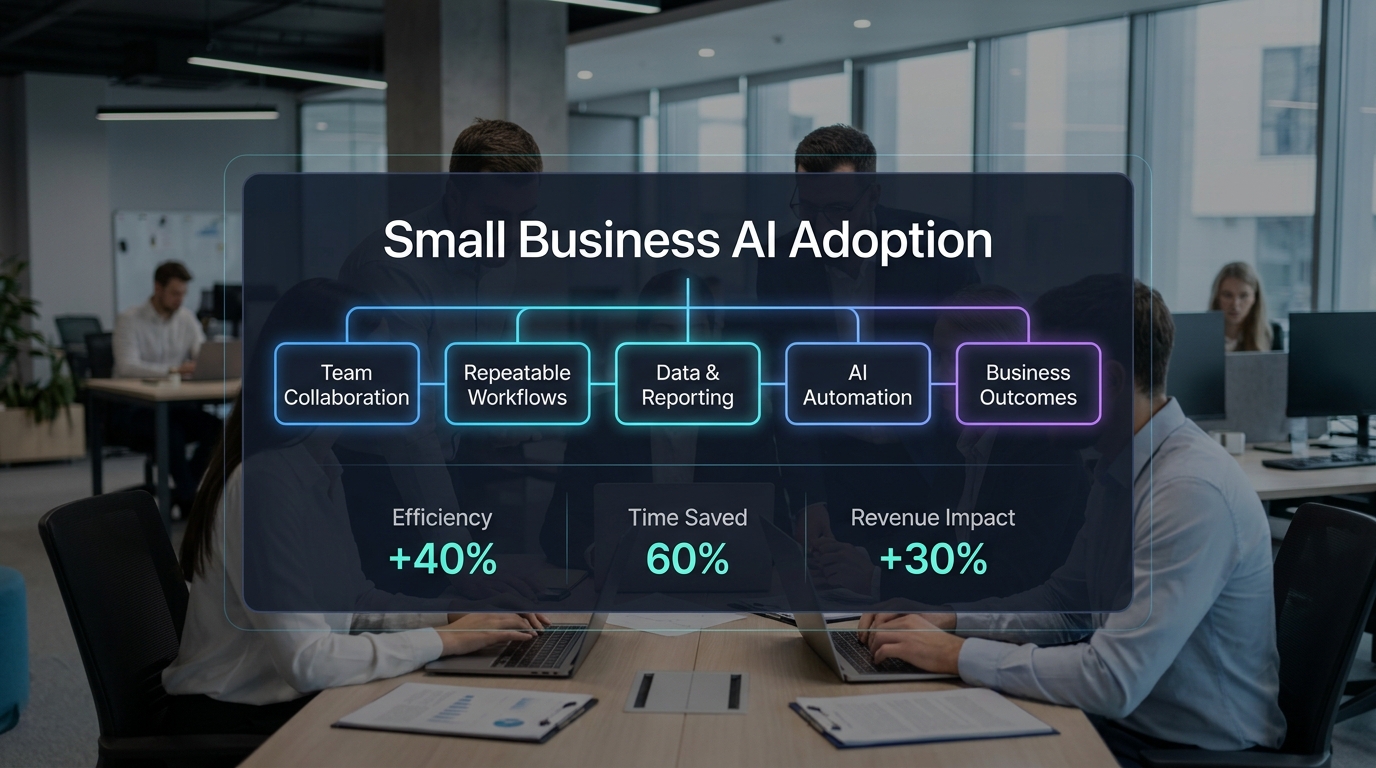
Small Business AI Adoption: Why Teams Create More AI Leverage Than Tools Alone
Small business AI adoption is not simply about who has access to the newest tools. The more important question is whether a business has enough operational structure to turn AI into leverage. For founders and business owners, this matters because AI does not automatically replace headcount, remove complexity, or create growth. In many cases, AI performs best when there is already a team, a repeatable workflow, and a clear business outcome attached to the work.
Key Takeaways
- AI adoption tends to accelerate when a business has repeatable workflows, customer volume, and team handoffs worth improving.
- Solo operators can gain major leverage from AI, but higher-revenue operators usually have clearer systems and better data to work with.
- AI is not a substitute for business process design. It amplifies the quality of the system it is placed inside.
- Founders should prioritize AI use cases around revenue, customer experience, delivery speed, and internal bottlenecks.
- The strongest AI advantage belongs to businesses that combine human judgment, clean workflows, and automation discipline.
The Real Pattern Behind AI Adoption
A common assumption is that AI will create a wave of one-person companies that can do the work of large teams. That will happen in some categories. A skilled consultant, creator, developer, or specialist can now research, write, analyze, prototype, and sell with far more leverage than before.
But for most established businesses, the more useful pattern is different. AI adoption often grows when there is enough operational surface area to justify it. Once a business has employees, customer requests, sales follow-ups, reporting needs, onboarding steps, and delivery workflows, the cost of inefficiency becomes visible.
A solo founder may be able to keep everything in their head. A five-person team cannot. A 25-person team definitely cannot. The moment work starts moving between people, the business needs systems. That is where small business AI adoption becomes practical rather than experimental.
Why Headcount Can Increase AI Readiness
Headcount is often treated as something AI is supposed to reduce. In reality, headcount can be the reason AI becomes useful in the first place.
A business with a small team usually has repeated patterns: the same customer questions, the same proposal formats, the same project updates, the same invoices, the same CRM gaps, and the same internal decisions. These patterns are ideal candidates for AI-supported workflows.
For example, a local services company with eight employees may have three people touching every new lead. One person answers the inquiry, another qualifies the customer, and a third prepares the estimate. Without a system, details get lost. With AI, the company can summarize the inquiry, score urgency, draft a response, create a task in the CRM, and prepare a first version of the estimate. The team still makes the decision, but the manual coordination shrinks.
The value is not that AI replaces the team. The value is that the team stops spending hours repeating low-value steps.
Revenue Scale Matters More Than Company Size
One of the most important insights for founders is that AI adoption is often linked to revenue scale, not just headcount. A high-revenue solo consultant may adopt AI faster than a small employer with messy operations. A growing ecommerce company may have more AI opportunities than a larger but slower professional services firm.
Why? Because revenue usually creates pressure. More customers mean more support requests. More deals mean more follow-up. More delivery volume means more internal coordination. More data means more reporting and decision-making demand.
AI becomes useful when there is something costly to improve.
A $50,000 solo business may use AI casually for content ideas. A $750,000 solo business may use AI to draft client strategy documents, analyze sales calls, generate onboarding plans, summarize research, and maintain a knowledge base. The difference is not just access to tools. It is workflow maturity, customer volume, and a clearer connection between time saved and revenue protected.
AI Amplifies Systems, Not Chaos
The biggest mistake small businesses make with AI is bolting tools onto broken processes. If the team already has unclear roles, incomplete data, inconsistent naming conventions, and no decision owner, AI will not fix the problem. It will usually make the confusion faster.
Before automating, founders should ask three questions:
- Is this workflow already repeatable?
- Do we know what a good output looks like?
- Who reviews, approves, or acts on the AI output?
If the answer is unclear, the first step is process design, not automation.
Consider a marketing agency that wants to use AI for client reporting. If every account manager tracks performance differently, uses different naming rules, and explains results in a different format, AI-generated reports will be inconsistent. But if the agency standardizes metrics, inputs, reporting structure, and review steps, AI can draft useful monthly reports in minutes.
The tool is not the strategy. The operating system is the strategy.
Where Business Owners Should Start
Founders do not need to automate everything. They need to identify the few workflows where AI can create measurable leverage. The best starting points usually have four traits: repetition, clear inputs, clear outputs, and business impact.
Here are practical examples:
- Sales follow-up: AI can summarize discovery calls, draft personalized follow-ups, create CRM notes, and remind the team when a lead goes cold.
- Customer support: AI can categorize tickets, suggest responses, surface knowledge base articles, and identify recurring product or service issues.
- Operations: AI can turn messy meeting notes into task lists, update project boards, and flag overdue handoffs.
- Content production: AI can help repurpose webinars, sales calls, and customer questions into blog outlines, email drafts, and social posts.
- Finance and admin: AI can classify expenses, draft invoice reminders, summarize cash flow notes, and prepare weekly operating updates.
The goal is not to chase novelty. The goal is to remove friction from work the business already does every week.
The Founder’s AI Adoption Checklist
Before investing heavily in AI automation, founders should run a simple readiness check.
- Workflow clarity: Can the team describe the current process in five to seven steps?
- Data access: Are the right documents, CRM fields, support tickets, or project records available?
- Decision rights: Does someone own the output and know when to override AI?
- Success metric: Will the workflow save time, increase conversion, reduce errors, or improve customer experience?
- Risk level: Could a wrong output damage customer trust, compliance, or revenue?
This checklist keeps small business AI adoption grounded in operational value. It also prevents teams from automating sensitive work before they have the right controls.
How Agencies Can Help Turn AI Into Operating Leverage
Many business owners are already testing AI tools. The gap is implementation. They have prompts, subscriptions, and experiments, but not a connected system that improves how the company runs.
This is where an agency partner can create value. The work is not just selecting tools. It is mapping workflows, finding automation opportunities, designing human review points, connecting systems, and training the team to use AI consistently.
At Prime Solution Media, we approach AI through the lens of business operations. That means looking at where work slows down, where teams repeat themselves, where customer experience breaks, and where better systems can create measurable leverage. AI is most valuable when it is connected to the way the business already sells, serves, delivers, and learns.
For founders, the right question is not which AI tool should we buy? The better question is which part of our operating model would improve if the team had faster research, cleaner handoffs, better summaries, and smarter automation?
Conclusion: AI Rewards Operational Discipline
The next phase of small business AI adoption will not be won by the companies using the most tools. It will be won by the companies that know where AI belongs inside their workflows.
Solo operators will continue to gain leverage, especially when they have strong expertise, clear offers, and disciplined systems. But small teams may have an even bigger opportunity because they have more handoffs, more customer interactions, and more repeatable work to improve.
AI does not remove the need for people, process, or judgment. It raises the return on all three. For founders, the strategic move is to stop treating AI as a side experiment and start treating it as part of the operating model. When the workflows are clear and the team knows how to use the output, AI becomes more than a productivity tool. It becomes business infrastructure.




