
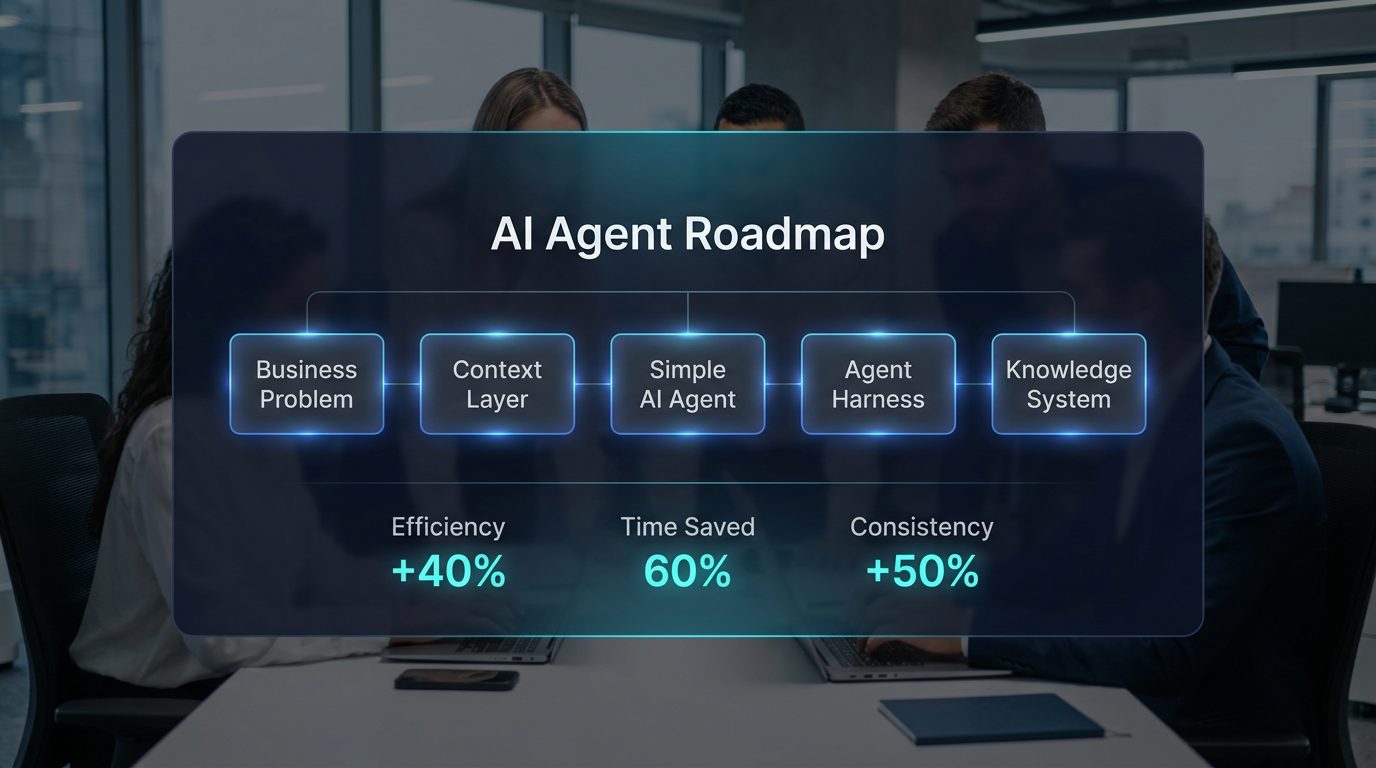
 Most founders start with AI the same way: they open a tool, ask it to write something, summarize something, or brainstorm an idea. That is useful, but it is not the real leverage. A practical AI agent roadmap helps a business move from casual AI usage to repeatable systems that support marketing, sales, operations, finance, and client delivery.
The gap is not usually the tool. Claude, ChatGPT, Gemini, and other platforms can all be powerful. The gap is the operating structure around the tool: context, workflow design, controls, knowledge, decision rights, and team adoption.
Key Takeaways
- AI becomes valuable when it moves from chat to repeatable business workflows.
- Founders should focus less on clever prompts and more on business context, process design, and quality control.
- No-code AI agents can support sales follow-up, content operations, reporting, onboarding, and internal knowledge retrieval.
- An agent harness — the rules, context, permissions, and review points around an AI system — is where long-term leverage lives.
- Businesses should build tool-agnostic AI systems instead of depending entirely on one model or platform.
The Real Shift: From Chatting to Building
Using AI as a chatbot is like hiring a talented assistant and giving them no job description, no files, no examples, no authority levels, and no feedback loop. You may still get something useful, but the result will be inconsistent.
Building with AI is different. It means designing a system where AI has a defined role inside a business process. Instead of asking, Can you write a sales email?, the business creates a workflow where AI reviews lead data, checks the prospect segment, drafts a personalized message, applies brand rules, flags missing information, and sends the draft to a human for approval.
That difference matters for business owners. Casual AI usage saves minutes. Systemized AI can save hours, reduce handoffs, improve consistency, and create faster decision cycles across the company.
Step 1: Start With the Business Problem, Not the AI Tool
A common mistake is to begin with a feature list. Founders see agents, memory, code tools, document upload, voice, image generation, or automation connectors and immediately ask what they can do with them. That usually creates scattered experimentation.
A better approach is to begin with recurring operational friction. Look for work that is frequent, rules-based, context-heavy, and currently slowed down by manual review or messy handoffs.
Good candidates include:
- Preparing weekly client reports from multiple data sources.
- Turning sales calls into CRM notes, follow-up emails, and next-step tasks.
- Creating first drafts of briefs, proposals, landing pages, and campaign plans.
- Answering internal team questions from SOPs, policies, and project documentation.
- Reviewing finance, delivery, or support data for anomalies before a manager checks it.
This keeps AI implementation grounded in measurable business outcomes instead of novelty.
Step 2: Give AI the Context It Needs to Stop Guessing
Many teams think AI performance depends mainly on prompt writing. Prompt quality matters, but business context matters more. The same AI model that gives a generic answer to a vague request can become genuinely useful when it understands the company, the customer, the workflow, the data structure, and the approval rules.
For example, an AI finance assistant cannot reliably help with reconciliation if it does not understand the chart of accounts, cost centers, approval flow, reporting format, and exceptions that matter to the business. A marketing assistant cannot produce strong campaign assets if it does not know the positioning, audience segments, offer structure, tone, proof points, and compliance boundaries.
Founders should create a practical context layer for AI systems. This may include:
- Brand voice and messaging guidelines.
- Customer personas and buying objections.
- Standard operating procedures.
- Examples of strong and weak outputs.
- Decision rules for when AI should act, ask, or escalate.
- Data definitions and naming conventions.
This is where many AI projects become useful. The model stops guessing and starts operating with business-specific reference points.
Step 3: Build a Simple AI Agent Before Building a Complex One
An AI agent does not need to be a fully autonomous system making major decisions. For most businesses, the best first agent is narrow, supervised, and connected to one workflow.
Consider a lead qualification agent for a service business. Its job is not to replace the sales team. Its job is to review new inbound leads, compare them against qualification criteria, summarize fit, suggest a priority level, draft a reply, and create a CRM task. A human still approves the message and owns the relationship.
Or consider a content operations agent for an agency. It can take a recorded client strategy call, extract campaign themes, generate a content brief, suggest distribution angles, and prepare tasks for the creative team. The strategist still decides what goes live.
The first agent should prove three things:
- It saves time in a real workflow.
- It improves consistency or reduces missed steps.
- The team trusts the output enough to use it repeatedly.
If those conditions are not met, adding more automation will only increase noise.
Step 4: Create an Agent Harness
The agent itself is only part of the system. The harness around the agent is what makes it safe, useful, and scalable. An agent harness includes the operating rules, data access, prompts, integrations, review points, logging, fallback paths, and human responsibilities.
For founders, this is an important mental model. AI leverage does not come from letting tools run freely. It comes from giving them the right boundaries.
A practical agent harness answers questions such as:
- What information can the AI access?
- What can it draft, recommend, or execute?
- When does a human need to review the output?
- What quality standard should it follow?
- Where are outputs stored?
- How are errors, exceptions, and edge cases handled?
- Who owns the workflow if the automation fails?
This is especially important for agencies, consultants, and service businesses where client trust depends on quality control. AI can accelerate delivery, but the business still needs clear accountability.
Step 5: Use AI for Creation, but Do Not Remove Human Judgment
AI is strong at generating drafts, variants, summaries, outlines, wireframes, concepts, scripts, and process documentation. This makes it valuable for creative and operational teams. But business owners should be careful not to confuse output volume with business value.
A content team that uses AI to produce more posts without a clearer strategy may simply create more average content. A video team that automates editing without style rules may lose pacing, taste, and brand feel. A proposal team that generates faster documents without better qualification may still chase poor-fit deals.
The better model is human-led, AI-assisted production. AI handles research synthesis, first drafts, pattern recognition, versioning, and repetitive formatting. Humans handle strategy, judgment, taste, client nuance, and final approval.
Step 6: Avoid Feature Chasing
AI tools are adding features quickly. That creates a temptation to test everything. For busy founders, this is rarely productive. The question should not be, What new feature can we try? The question should be, Which feature removes a real bottleneck in our operating system?
A simple test helps. Before adopting a feature, ask:
- Does it support a workflow we already run every week?
- Can we measure the time saved or quality improved?
- Will the team actually use it?
- Does it create new risk, confusion, or maintenance work?
- Can the process still run if we switch AI providers?
This last question matters. Businesses should avoid putting all operational knowledge inside one AI platform. The strongest AI systems are portable: documented prompts, clean SOPs, structured data, and workflows that can adapt as tools change.
Step 7: Build a Business Knowledge System
One of the most useful AI applications is a second brain for the business. Not a personal notes app, but an organized knowledge layer that helps the team find answers, reuse decisions, and onboard faster.
For example, a growing agency can build a knowledge system containing client playbooks, offer details, proposal examples, reporting standards, onboarding checklists, and campaign retrospectives. An AI assistant can then help the team answer questions like, What reporting format does this client prefer?, Which offer angle performed best for this segment?, or What steps are required before a campaign launch?
This kind of system reduces dependency on tribal knowledge. It also makes future AI agents more effective because they have better context to work from.
Where Prime Solution Media Fits
Prime Solution Media helps founders and teams turn AI interest into practical operating systems. That usually means starting with workflow discovery, identifying high-value use cases, designing the context layer, building supervised automations, and creating governance that fits the business.
The goal is not to add AI for the sake of it. The goal is to remove operational drag, improve consistency, and help teams work with better information. For agencies and service businesses, that can mean faster reporting, stronger content operations, smoother client onboarding, cleaner sales follow-up, and more reliable delivery systems.
The most effective AI implementation is rarely a single big launch. It is a sequence of focused improvements that compound.
Strategic Conclusion
The businesses that benefit most from AI will not be the ones with the longest list of tools. They will be the ones that learn how to turn tools into systems.
A strong AI agent roadmap starts with real workflow friction, adds business-specific context, builds narrow supervised agents, wraps them in clear controls, and improves them through team feedback. That is how founders move from experimenting with AI to building operational leverage.
Chatting with AI is a useful starting point. Building with AI is where the business value begins.




