
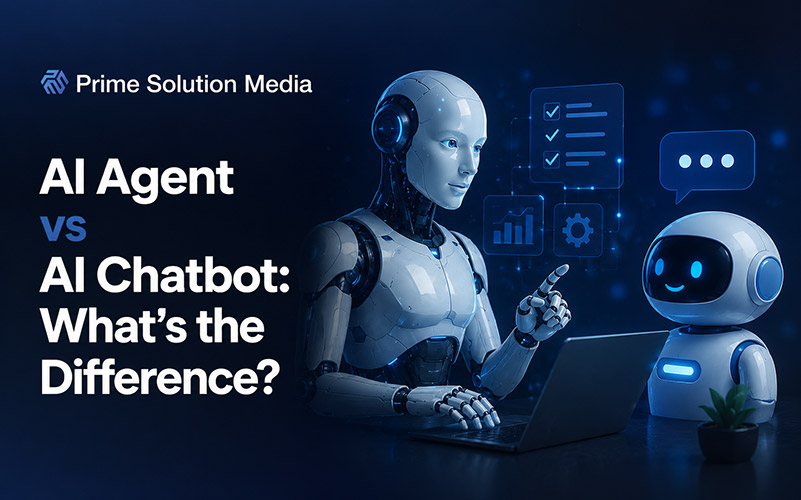
Key Takeaways
- AI chatbots mainly respond to conversations, while AI agents can understand goals, make decisions, and complete multi-step tasks.
- The difference between AI agents and chatbots comes down to their level of independence, reasoning, and ability to take action.
- Not every business needs an AI agent; chatbots still work well for quick answers, support, and routine customer interactions.
- Choosing between an AI agent vs chatbot depends on your goals, workflow complexity, and the type of experience you want to create.
AI has changed the way we interact with technology, but the line between an AI agent and a chatbot can still feel blurry. Both can answer questions, hold conversations, and help users complete tasks, which is why many people use the terms interchangeably. However, they are built for different purposes.
A chatbot usually focuses on responding to requests, while an AI agent can take more independent steps to reach a goal. Understanding the difference between an AI agent vs chatbot helps businesses choose the right tool instead of investing in technology that does not match their needs.
Before comparing them, it helps to understand what a chatbot actually is.
Why Do People Confuse These Two?
AI agents and chatbots often get placed in the same category because they both use language to interact with people. When you type a question and receive a helpful reply, it can feel like you are using the same kind of technology every time. That is why the topic of AI agent vs chatbot often creates confusion.
They Both Talk Like Humans
Modern tools have become much better at understanding everyday language. From customer support replies to personal assistance, conversational AI systems are designed to make interactions feel natural and easy.
But They Do Very Different Jobs
The real difference between AI agents and chatbots appears when you look beyond the conversation. A chatbot mainly provides responses based on its purpose, while an AI agent can work toward a goal, make decisions, and complete multiple steps. To understand this gap better, we first need to look at how chatbots work.
What Is a Chatbot?
A chatbot is a software system that interacts with users through text or voice conversations. It simulates human-like dialogue to answer questions, share information, and assist with basic tasks without requiring human involvement.
Not all chatbots are fully AI-based, but modern versions often use natural language processing (NLP) to understand user input and generate relevant responses.
In the context of AI agent vs chatbot, chatbots are usually seen as the starting point because they are one of the most common forms of conversational technology.
What It Does Well
Chatbots are effective for fast, consistent communication. They handle FAQs, customer support, booking requests, and other routine queries where simple, predictable responses are enough.
Where It Starts to Feel Limited
However, chatbots work within set boundaries. They respond to inputs but do not independently make decisions or manage complex workflows. This limitation becomes clearer when comparing chatbot vs AI assistant, where assistants handle broader tasks and more flexible support.
What Is an AI Agent?
An AI agent is a system that understands a goal, plans steps, and takes action to complete tasks. Unlike a chatbot that mainly responds in conversation, an AI agent can solve problems, use tools, and adjust their approach based on results. This is where the difference in AI agent vs chatbot becomes clearer.
AI agents can also handle decision-making, problem-solving, and interactions with external systems. They are often used in areas like software development support, IT automation, code generation, and business workflows.
They rely on large language models (LLMs) and natural language processing to interpret instructions step by step and decide when to use external tools to complete tasks effectively.
How It Works Behind the Scenes
An AI agent usually follows a simple process:
- Understands the user’s goal or request.
- Breaks the task into smaller steps.
- Chooses actions based on available information.
- Reviews progress and adjusts when needed.
This ability allows AI agents to handle tasks that require more than just giving an answer.
Autonomous AI Agents Explained
When people search for autonomous AI agents explained, they are often looking at systems that can operate with less human input. These agents can plan, make choices, and complete workflows based on set instructions and goals.
Examples of AI Agents in Real Use
Some common examples of AI agents include systems that manage schedules, analyze data, assist with research, automate business processes, or support software development. They can help teams reduce repetitive work and focus on higher-level decisions.
As AI continues to develop, the gap between simple responses and independent task completion becomes clearer.
AI Agent vs Chatbot: How They Compare
Now that we have looked at both technologies separately, the difference becomes easier to spot when they are placed side by side. The confusion around AI agent vs chatbot usually comes from what users see on the surface.
| Area | Chatbot | AI Agent |
|---|---|---|
| Main job | Answers questions and provides information | Works toward goals and completes tasks |
| Level of action | Reacts to user input | Takes steps based on the goal |
| Memory and context | Usually follows the current conversation | Can manage longer processes and context |
| Task handling | Handles simple, repeated requests | Manages multi-step tasks and workflows |
| Response style | Gives direct replies | Plans actions before responding |
| Best use case | Support, FAQs, and basic guidance | Automation, research, and complex tasks |
| Human input needed | Often needs user direction | Can work with less ongoing input |
What the User Sees vs What Happens in the Background
From the outside, AI agents and chatbots can look almost identical. Both use conversations to help users, but the work happening behind the scenes creates the real difference.
A chatbot typically:
- Answers questions based on available information.
- Guides users through simple tasks.
- Responds when a user starts the conversation.
An AI agent can:
- Understand a larger goal instead of one request.
- Decide the next steps needed to complete a task.
- Use tools, data, or systems to move things forward.
- Adjust its actions based on new information.
Chatbots are still useful for many everyday needs, especially when quick answers and support are the main goals. AI agents simply take the process further by handling more complex work with less manual input.
Is a Chatbot the Same as an AI Assistant?
The terms chatbot and AI assistant are often used together, but they are not always the same thing. Both help users interact with technology through natural conversations, yet their abilities can differ depending on how they are built. The discussion around chatbot vs AI assistant comes down to the level of support each one provides.
Chatbot vs AI Assistant
A chatbot usually focuses on answering questions and guiding users through specific requests. It works well for customer support, basic information, and repeated conversations.
An AI assistant often goes a step further by helping users complete broader tasks. It may remember context, connect with tools, and support actions beyond simple replies.
For example:
A chatbot can answer “What are your business hours?”
An AI assistant may help schedule a meeting or organize information.
Where Conversational AI Systems Sit in the Mix
Conversational AI systems include a range of tools, from simple chatbots to more advanced AI agents. They all aim to make interactions easier, but the level of reasoning and action can vary.
When looking at AI agent vs chatbot, businesses should focus on what they actually need. The right choice depends on whether they need quick conversations or support that can handle larger goals and workflows. This makes choosing the right AI solution a practical business decision, not just a technology choice.
Which One Should You Use?
Choosing between an AI agent and a chatbot is less about picking the newer option and more about understanding what your business actually needs.
When a Chatbot Is Enough
A chatbot can be the right fit when your main goal is faster communication. It works well for answering common questions, helping customers find information, collecting basic details, and providing support without long wait times.
For many businesses, a chatbot can improve customer service, guide website visitors, and handle routine requests effectively.
When an AI Agent Gives More Value
An AI agent becomes more useful when tasks require planning, decision-making, or multiple steps. If you need help with sales follow-ups, internal workflows, research, or operations, an AI agent can handle more complex goals.
Understanding what an AI agent is helps businesses see why it fits situations where simple replies are not enough.
The choice between AI agent vs chatbot comes down to your goals, and the next step is answering some common questions people ask before making that decision.
Frequently Asked Questions
What is the main difference between an AI agent and chatbot?
The main difference between an AI agent vs chatbot is how they work. A chatbot mainly responds to questions, while an AI agent can plan actions and complete tasks with less human input.
Can a chatbot act like an AI assistant?
A chatbot can provide some assistant-like features, but chatbot vs AI assistant depends on capability. AI assistants usually handle broader tasks beyond basic replies.
When should a business choose an AI agent instead of a chatbot?
A business should choose an AI agent when it needs automation, task handling, or support for more complex workflows. Knowing what an AI agent is helps identify when it fits.
Conclusion
Choosing between an AI chatbot and an AI agent isn’t about finding the trendiest tool; it is about matching technology to your operational workflows. While chatbots excel at delivering quick, consistent communication for routine support, autonomous AI agents provide the strategic reasoning and independence required to automate complex, multi-step business processes.
When evaluating an AI agent vs chatbot, building, integrating, and maintaining these advanced digital systems requires a structured, process-driven framework rather than one-off fixes.
At Prime Solution Media, we help organizations assess their workflows, document clear requirements, and implement measurable AI automation solutions.
Contact Prime Solution Media today to design the right digital infrastructure for your business.




One Comment