
AI Governance for Business: How Founders Can Move Fast Without Creating Operational Risk
AI governance for business is no longer a concern reserved for governments, enterprise legal teams, or frontier AI labs. It is becoming a practical operating requirement for founders, agencies, and growing companies that want to use AI without creating confusion, compliance risk, or fragile workflows.
The central challenge is simple: AI capability is moving faster than most organizations are designed to absorb. New models, tools, agents, and automation platforms are improving quickly. Meanwhile, most businesses still make operational decisions through quarterly planning, informal tool adoption, scattered documentation, and reactive risk management.
That mismatch creates a gap. Not just a policy gap, but an execution gap. The companies that close it will use AI more confidently. The companies that ignore it may find themselves with disconnected tools, unclear ownership, inconsistent outputs, and avoidable operational risk.
Key Takeaways
- AI adoption should be treated as an operating system change, not just a software upgrade.
- Founders need lightweight AI governance before automation spreads across sales, marketing, operations, finance, and customer service.
- Governance does not have to slow teams down. Clear rules often help teams move faster because they reduce uncertainty.
- The biggest risks for small and mid-sized businesses are usually not catastrophic AI failures. They are bad handoffs, unclear accountability, poor data usage, and automation without review.
- Agencies and operators should build AI systems with ownership, approvals, escalation paths, and performance monitoring from the start.
The Real AI Gap Inside Most Businesses
Many founders think the AI challenge is choosing the right tool. Should the team use ChatGPT, Claude, Gemini, Zapier, Make, HubSpot AI, Notion AI, or a custom agent? Tool selection matters, but it is rarely the core problem.
The deeper issue is that AI is being added to businesses faster than their workflows are being redesigned. A marketing assistant starts using AI to draft campaigns. A sales rep uses it to summarize calls. An operations manager connects an automation to update the CRM. A customer support lead experiments with AI replies. Each use case might be helpful in isolation, but without shared rules, the business slowly becomes harder to manage.
Common symptoms include:
- No one knows which AI tools are approved.
- Client, customer, or internal data is pasted into tools without a clear policy.
- AI-generated outputs are used without review standards.
- Automations break silently because no one owns the workflow.
- Teams save time locally but create rework downstream.
- Managers cannot tell whether AI is improving quality or simply increasing volume.
This is why AI governance for business needs to be practical. It is not about creating a 60-page policy that no one reads. It is about building a simple framework that lets your team use AI responsibly, consistently, and with measurable business value.
Governance Is Not the Opposite of Speed
Founders often worry that governance will slow adoption. In reality, the absence of governance often slows teams down more.
When there are no rules, every AI initiative becomes a one-off debate. Can we use this tool? Can we connect it to customer data? Who approves this automation? What happens if the output is wrong? Should legal review this? Should the founder decide?
That uncertainty kills momentum. Teams either move too slowly because they are afraid of making the wrong call, or they move too quickly and create risk the business discovers later.
A lightweight governance layer gives people decision clarity. For example, a founder might define three categories of AI use:
- Low-risk AI use: brainstorming, internal drafts, meeting summaries, content outlines, research support, and admin assistance.
- Medium-risk AI use: customer-facing copy, sales follow-ups, CRM updates, reporting automation, and support response suggestions.
- High-risk AI use: financial decisions, legal interpretation, hiring decisions, medical or regulated advice, pricing changes, and unsupervised customer communication.
With this simple structure, the team knows what can be done freely, what needs review, and what requires leadership approval. That is governance that accelerates execution.
What AI Governance Looks Like for a Growing Business
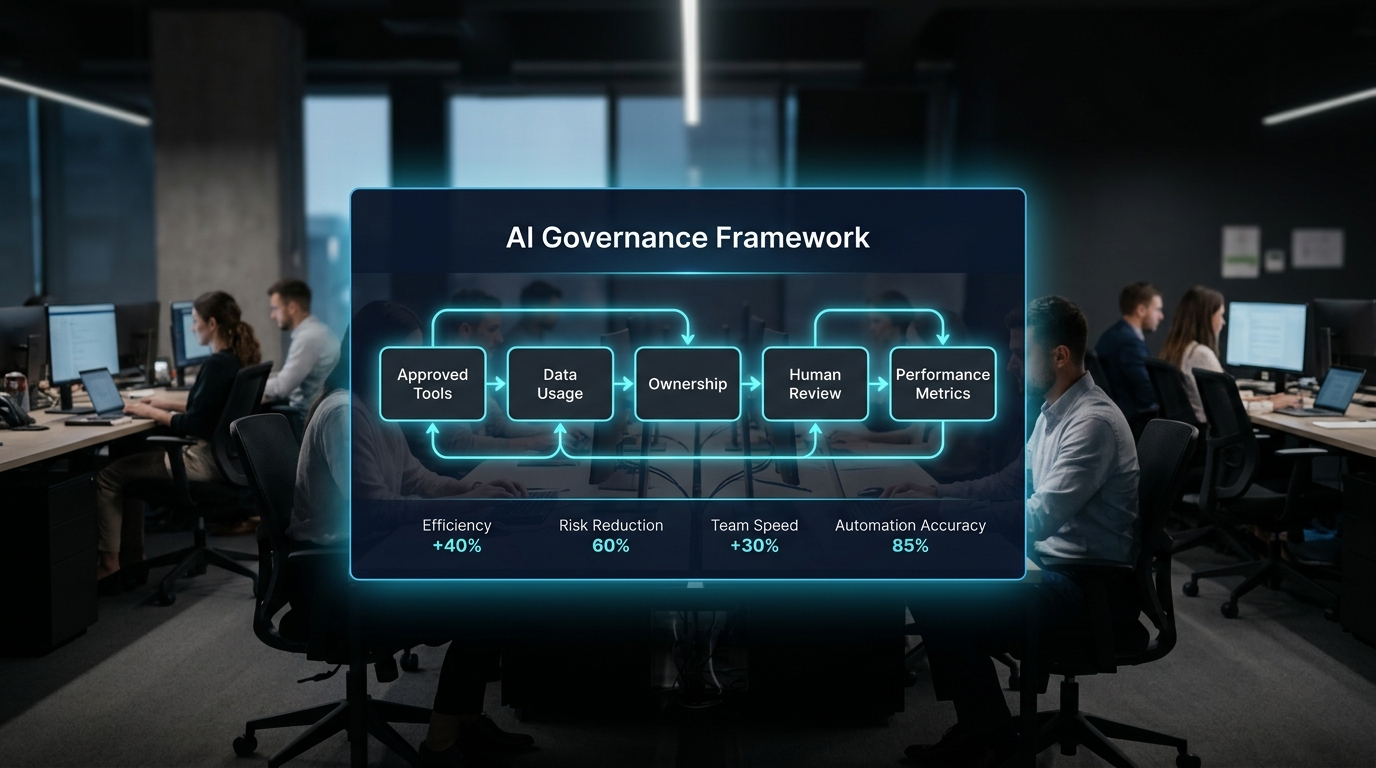
AI governance for business should answer five operational questions.
1. What AI tools are approved?
Start with a tool inventory. List every AI tool being used across the company. Include browser tools, embedded AI features inside existing software, automation platforms, AI note takers, chatbots, and internal agents.
Then decide which tools are approved, which are experimental, and which are not allowed for business data. This prevents shadow AI adoption, where employees use tools that leadership does not know exist.
2. What data can be used?
Data rules are essential. A small business may not need enterprise-grade compliance infrastructure, but it does need clear boundaries. Define whether the team can use customer names, emails, contracts, sales notes, call transcripts, financial numbers, internal strategy documents, or proprietary processes inside AI systems.
A practical rule: if the data would be sensitive in an email forwarded outside the company, it should not be used in an AI tool without approval.
3. Who owns each AI workflow?
Every automation should have an owner. If an AI workflow updates a CRM, sends reports, drafts proposals, routes leads, or generates customer messages, someone must be responsible for checking performance and fixing issues.
Without ownership, automation becomes technical debt. It may work for two months, then quietly break when a form field changes, a prompt becomes outdated, or a software integration fails.
4. Where does human review happen?
AI should not remove human judgment from important workflows. It should place human judgment at the right point in the workflow.
For example, an agency might use AI to create first drafts of client reports. But the account strategist should review insights, verify metrics, and approve recommendations before the report is sent. A sales team might use AI to draft follow-up emails, but reps should review tone, accuracy, and offer details before sending.
5. How will performance and risk be measured?
AI governance should include measurement. Track whether AI workflows improve speed, quality, cost, customer response time, conversion rate, or employee capacity. Also track errors, escalations, rework, and customer complaints.
If a workflow saves two hours per week but creates five hours of cleanup, it is not a win. If an AI assistant increases content output but lowers brand quality, it needs refinement. AI should be judged by business outcomes, not novelty.
Practical Examples for Founders and Agencies
Consider a service business that wants to automate lead qualification. Without governance, the team might connect a form to an AI model, score leads automatically, and route them to sales. That sounds efficient until the model misreads company size, ignores strategic accounts, or deprioritizes high-value referrals.
A better approach is to define the workflow clearly. AI can summarize the inquiry, classify the lead, suggest urgency, and recommend next steps. But a sales manager reviews the scoring logic weekly, and any lead above a certain deal size is automatically escalated to a human.
For a marketing agency, AI might support content production. The governance layer could include approved prompts, client data rules, brand voice checks, plagiarism review, fact-checking requirements, and final human approval. This allows the agency to increase production capacity without sacrificing trust.
For an operations team, AI might summarize support tickets and identify recurring problems. Governance would define which ticket data can be processed, who reviews the insights, how often the workflow is audited, and when a human must intervene.
In each case, governance does not block AI. It turns AI into a managed business process.
The Founder’s Role: Set the Operating Principles
Founders do not need to personally approve every AI use case. But they do need to set operating principles. These principles might include:
- AI can assist decisions, but humans remain accountable for business outcomes.
- No sensitive customer data goes into unapproved tools.
- Customer-facing AI outputs require review unless explicitly approved.
- Every automated workflow has an owner and a fallback process.
- AI systems are measured by value, reliability, and risk reduction.
These principles give managers and teams a shared decision-making model. They also make it easier to scale AI adoption across departments without creating chaos.
How Prime Solution Media Helps Businesses Build AI Responsibly
At Prime Solution Media, we help founders and business teams turn AI from scattered experiments into structured operating systems. That includes identifying high-value workflows, mapping operational risk, designing automation systems, and creating the governance layer needed to manage them over time.
Our focus is practical implementation. We help businesses understand where AI should be used, where human review is still necessary, and how to build workflows that improve speed without weakening quality or accountability.
For agencies, service businesses, and growth-stage teams, this often means creating AI workflow maps, tool policies, automation dashboards, review systems, and team adoption processes that fit the business as it actually operates.
Strategic Conclusion
AI is advancing faster than most business systems, and that gap will not close on its own. Founders who wait for perfect regulation, perfect tools, or perfect certainty will fall behind. But founders who adopt AI without structure may create operational risk that compounds quietly.
The better path is disciplined speed. Use AI where it creates real leverage. Put boundaries around data, decisions, and customer-facing outputs. Assign ownership. Measure results. Keep humans accountable for the systems they deploy.
AI governance for business is not bureaucracy. Done well, it is the foundation that lets a company move faster with more confidence. The businesses that build that foundation now will be better prepared for the next wave of AI capability, because they will not just be experimenting with tools. They will be redesigning how work gets done.




One Comment