
AI Implementation: The Next Growth Channel for Mid-Market Businesses
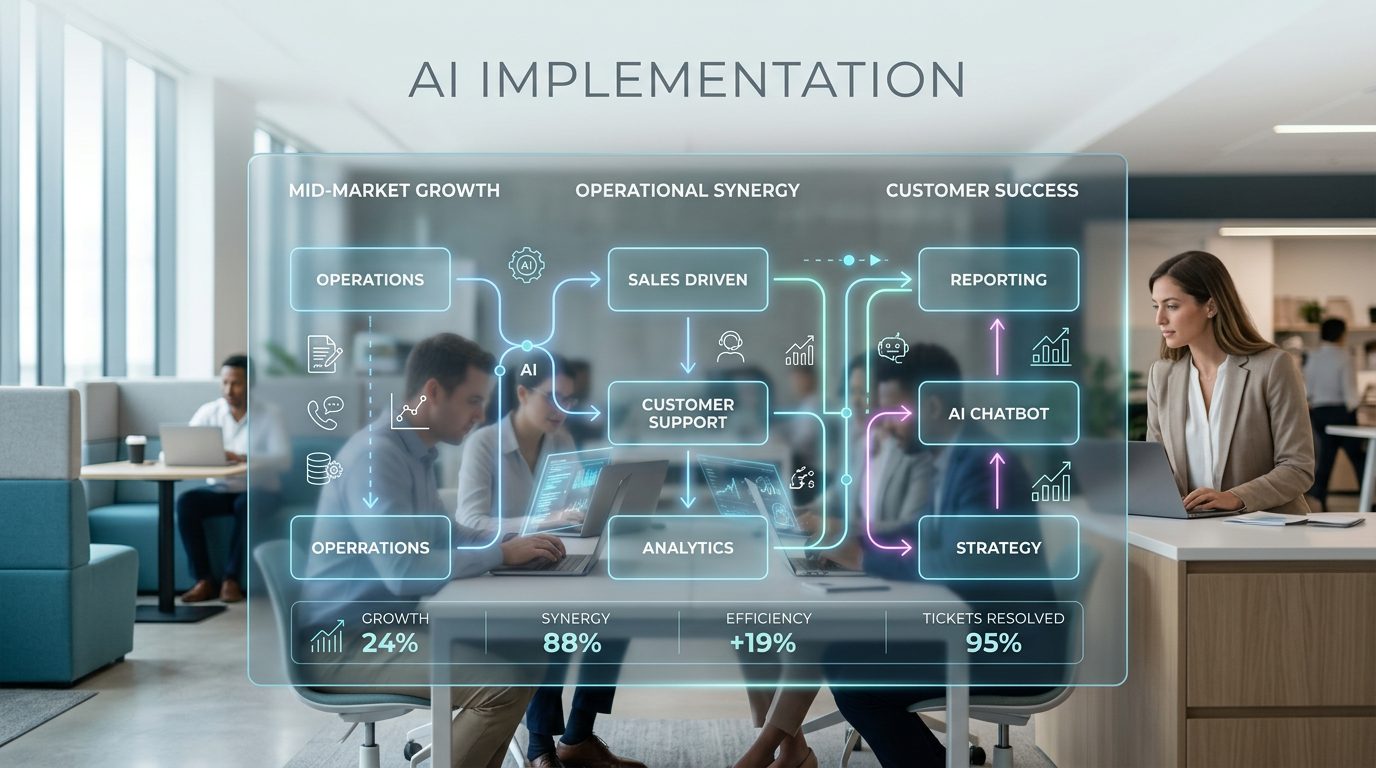
AI implementation is quickly moving beyond software adoption. For mid-market businesses, the opportunity is no longer just choosing which AI tool to use. The bigger question is how AI becomes embedded inside everyday operations, sales processes, customer service workflows, reporting systems, and decision-making loops.
Recent moves from major AI companies into consulting and implementation services point to a clear market shift. Businesses do not only need access to powerful models. They need help turning those models into operational systems that create measurable business value.
Key Takeaways
- AI implementation is becoming a strategic growth channel, not just a technology project.
- Mid-market businesses have a strong advantage because they are large enough to benefit from systems but agile enough to move quickly.
- The highest-value AI use cases are usually found inside repeatable workflows, not isolated experiments.
- Successful AI adoption requires process design, data readiness, team training, and workflow integration.
- Businesses that build AI into operations early can improve margins, speed, customer experience, and scalability.
Why AI Is Moving From Tools to Operational Systems
The first wave of AI adoption was tool-driven. Teams tested chatbots, writing assistants, meeting note takers, image generators, and productivity apps. These tools helped individuals move faster, but they often sat outside the core operating system of the business.
That phase was useful, but limited. A sales rep using AI to write an email is helpful. A sales operation where AI enriches leads, prioritizes accounts, drafts personalized outreach, updates the CRM, triggers follow-up tasks, and gives managers pipeline insights is much more valuable.
This is the difference between AI as a tool and AI as an operating layer.
Mid-market companies are now realizing that the real return on AI comes from embedding it into workflows. That means connecting AI to existing systems, defining approval rules, training teams, monitoring outputs, and redesigning processes around what AI can reliably automate or accelerate.
Why Mid-Market Businesses Are Well Positioned
Enterprise companies have large budgets, but they also have complex approval processes, legacy systems, compliance layers, and slow implementation cycles. Small businesses can move quickly, but they may not have enough operational volume to see significant gains from advanced automation.
Mid-market businesses sit in the sweet spot.
They usually have enough sales activity, customer interactions, internal reporting, service requests, hiring needs, and operational complexity to benefit from AI implementation. At the same time, they can often make decisions faster than large enterprises.
For a mid-market business, improving a process by 15 percent can have a meaningful impact. Reducing manual admin across a 30-person team, improving lead response time, automating client onboarding, or speeding up reporting can create real margin improvement.
This is why AI implementation is becoming a growth channel. It does not only reduce costs. It can increase capacity, improve customer experience, shorten sales cycles, and allow teams to handle more work without adding headcount at the same rate.
The Shift From AI Experiments to AI Infrastructure
Many companies have already run AI experiments. Someone in marketing used AI to draft social posts. A founder used it to summarize documents. A customer service lead tested a support chatbot. These experiments are useful learning moments, but they rarely change the business by themselves.
The next phase is AI infrastructure. This means building structured, repeatable systems where AI supports the business in predictable ways.
Examples include:
- A sales workflow where AI researches prospects, scores fit, drafts outreach, and prepares call briefs.
- A customer support workflow where AI categorizes tickets, suggests responses, and identifies recurring product issues.
- An operations workflow where AI summarizes project updates, flags delays, and creates weekly leadership reports.
- A finance workflow where AI reviews invoices, detects anomalies, and prepares cash flow summaries.
- A marketing workflow where AI analyzes content performance and recommends campaign adjustments.
The common thread is that AI is not being used randomly. It is being placed inside a defined process with clear inputs, outputs, owners, and quality controls.
Where AI Implementation Creates the Most Value
The best AI implementation opportunities are usually found where three things overlap: high repetition, high information volume, and clear business impact.
For example, customer service teams often handle repeated questions, product issues, refund requests, and onboarding support. AI can help by summarizing conversations, recommending responses, routing issues, and identifying patterns. This does not replace the entire support team. It gives the team better leverage.
Sales teams also benefit because they deal with research, personalization, CRM updates, call notes, objections, proposals, and follow-ups. AI can reduce the manual work that slows down revenue activity.
Operations teams can use AI to reduce the reporting burden. Instead of spending hours gathering updates from different tools, AI can pull from project management systems, summarize progress, identify blockers, and prepare a leadership-ready update.
In each case, the value is not in the AI model alone. The value comes from designing the workflow around a business outcome.
Practical Examples for Business Owners
Example 1: Turning lead response into a system
A mid-market services company receives inbound leads from ads, referrals, webinars, and its website. The team responds manually, but response time varies. Some leads get follow-up within minutes. Others wait a day.
An AI implementation approach could connect form submissions to a workflow that enriches the company profile, classifies lead quality, drafts a personalized response, creates a CRM task, and alerts the right salesperson. The sales team still owns the relationship, but AI removes the delay and admin friction.
Example 2: Improving client onboarding
A professional services firm has a detailed onboarding process involving contracts, intake forms, kickoff calls, shared folders, internal briefs, and project plans. The process works, but it depends heavily on one operations manager.
AI can help summarize client intake forms, generate internal onboarding briefs, create kickoff agendas, identify missing information, and prepare project templates. This makes onboarding more consistent and reduces dependency on one person.
Example 3: Making leadership reporting faster
A growing company has multiple departments reporting weekly updates. The founder spends hours reading documents, Slack threads, spreadsheets, and project boards.
With the right workflow, AI can summarize department updates, surface risks, highlight missed deadlines, identify revenue-impacting issues, and prepare a concise leadership report. The founder gets better visibility without chasing every detail manually.
What Businesses Often Get Wrong
The most common mistake is treating AI implementation as a software purchase. Buying access to an AI platform is not the same as changing how work gets done.
Another mistake is starting with the technology instead of the workflow. A business might ask, which AI tool should we use? A better question is, which process is slowing growth, creating waste, or limiting team capacity?
AI implementation should start with operational diagnosis. Where is the business losing time? Where are handoffs breaking down? Which tasks are repetitive but still require judgment? Which reports take too long to produce? Which customer interactions are inconsistent?
Once the workflow is clear, the AI layer can be designed around the actual business need.
The Building Blocks of Successful AI Implementation
Strong AI implementation usually includes five components.
- Process mapping: Understanding the current workflow before adding automation.
- Use case prioritization: Choosing initiatives based on impact, feasibility, and risk.
- Data and system access: Connecting AI to the right information sources in a secure way.
- Human review points: Defining where people approve, edit, or escalate AI-generated outputs.
- Measurement: Tracking time saved, revenue impact, quality improvements, or customer experience gains.
Without these pieces, AI projects often stay in pilot mode. With them, AI becomes part of how the company operates.
AI Implementation as a Growth Channel
When AI is implemented properly, it becomes more than an efficiency initiative. It becomes a growth channel because it expands what the business can do with the same resources.
A sales team can manage more opportunities. A support team can respond faster. A marketing team can test more campaigns. An operations team can handle more complexity. Leadership can make decisions with better information.
This matters for mid-market companies because growth often creates operational strain. More customers mean more support tickets. More sales activity means more CRM data. More projects mean more coordination. More team members mean more internal communication.
AI implementation can help the business absorb growth without adding unnecessary complexity. It creates leverage inside the operating model.
How Prime Solution Media Approaches AI Implementation
At Prime Solution Media, we see AI implementation as a business systems challenge, not just a technical trend. The goal is not to add AI everywhere. The goal is to identify where AI can improve speed, consistency, visibility, and scalability.
For many businesses, the best starting point is a practical workflow audit. This reveals where manual processes, disconnected tools, unclear handoffs, or repetitive tasks are limiting growth. From there, AI and automation can be introduced in a way that supports the team rather than overwhelming it.
The strongest implementations are usually focused and measurable. One improved onboarding process, one faster sales workflow, or one better reporting system can create momentum. Once the team sees value, the business can expand AI into other areas with more confidence.
Conclusion: The Advantage Goes to Operators
AI implementation is becoming one of the most important growth opportunities for mid-market businesses. The companies that benefit most will not be the ones that chase every new tool. They will be the ones that think operationally.
The real question is not whether AI can help. In most businesses, it can. The better question is where AI should be embedded first to create measurable leverage.
Mid-market companies that answer that question well can build faster workflows, stronger customer experiences, better reporting, and more scalable teams. As AI moves from standalone tools into embedded operational systems, the advantage will go to business owners and operators who know how to turn technology into execution.




