
AI Operating Model: Why Systems Decide Which Businesses Get Real Leverage
An AI operating model is becoming more important than the AI tools themselves. The businesses getting the most value from AI are not always the ones with the smallest teams, the largest budgets, or the most experimental founders. They are the ones with enough operational structure to turn AI into repeatable leverage.
This matters for founders and business owners because AI adoption is not simply a question of who signs up for more software. It is a question of whether the business has workflows, data, people, and decision rights that allow AI to improve how work actually gets done.
Key Takeaways
- AI adoption tends to accelerate when a business has repeatable workflows, clear handoffs, and enough operational volume to justify automation.
- Small teams can often create more AI leverage than solo operators because there are more recurring processes to improve.
- Higher-revenue solo businesses often adopt AI faster because they usually have better systems, cleaner data, and more room to experiment.
- The real advantage is not using AI as a chatbot. It is building an AI operating model around specific business outcomes.
- Founders should focus less on replacing people and more on combining human judgment with AI-enabled workflows.
The Misread: AI Does Not Automatically Favor the Smallest Team
A common assumption is that AI will make the one-person company dramatically more powerful than a team-based business. There is some truth in that. A capable operator can now write proposals faster, analyze data, draft content, research competitors, build prototypes, and automate admin work with tools that were not available a few years ago.
But the assumption misses something important: leverage requires surface area. A business with a few employees usually has more customer interactions, more internal handoffs, more recurring tasks, more documentation needs, and more places where inconsistency shows up. That gives AI more practical opportunities to create value.
A solo consultant may use AI to draft emails and summarize calls. Useful, but limited. A ten-person service company can use AI to qualify leads, route customer inquiries, summarize sales calls, generate first-draft proposals, update CRM fields, create onboarding checklists, and flag delivery risks. The tool is not more powerful in the second business. The operating environment is.
Why Revenue Scale Often Predicts AI Adoption
Another useful pattern is that AI adoption often tracks revenue scale. Larger businesses, whether solo or team-based, are more likely to use AI seriously than smaller ones. That is not just because they can afford subscriptions.
Higher-revenue businesses usually have more defined processes. They know where leads come from. They have repeatable sales conversations. They have some form of CRM, project management tool, customer database, content library, or reporting system. That existing structure gives AI something to plug into.
Lower-revenue businesses often face a different problem. Their workflows may still live in the founder’s head. Customer data may be scattered across email, notes, spreadsheets, and chat threads. Offers may change frequently. Delivery may depend on improvisation. In that environment, AI can still help, but it can also automate confusion.
This is why the phrase AI operating model matters. Without an operating model, AI becomes a collection of disconnected experiments. With one, it becomes part of how the company sells, serves, reports, learns, and scales.
What an AI Operating Model Actually Includes
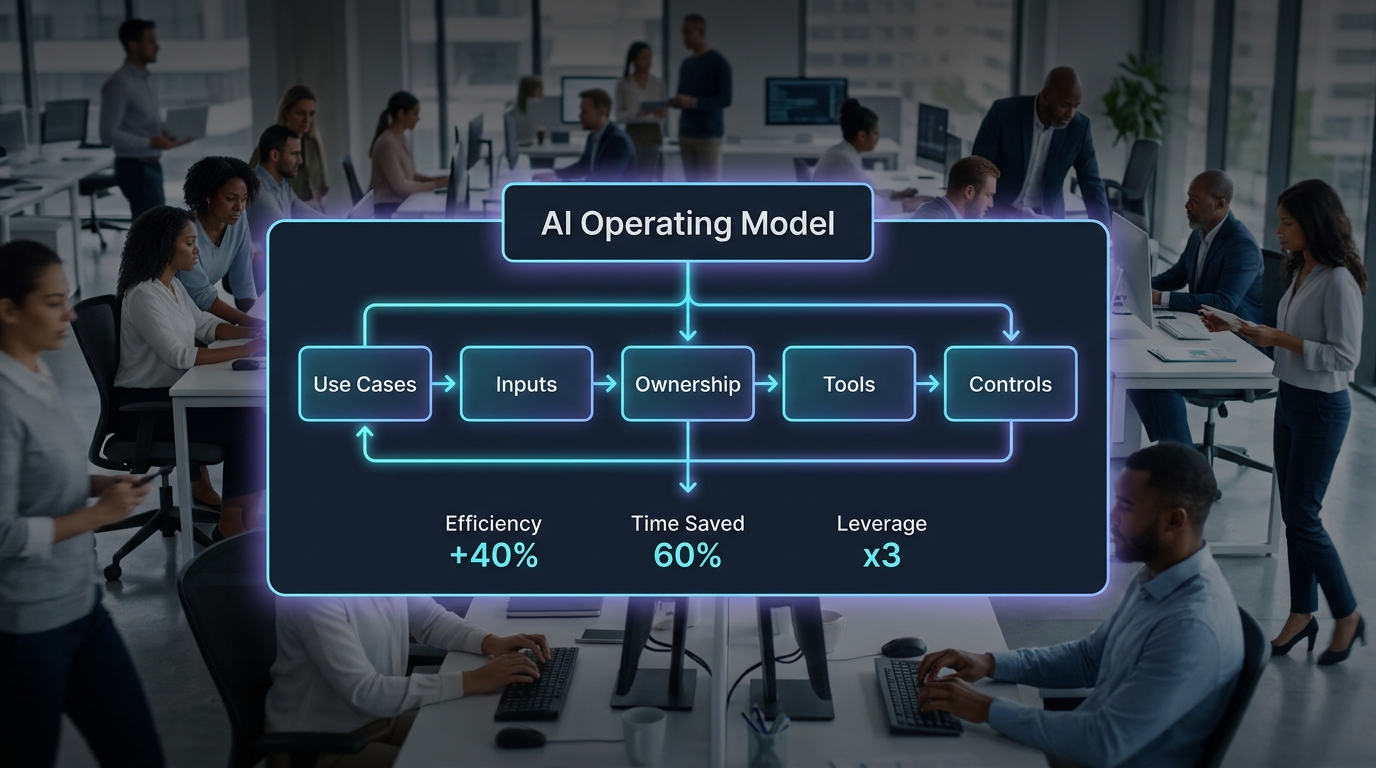
An AI operating model does not need to be complicated. For most small and mid-sized businesses, it starts with five practical decisions.
- Use cases: Which workflows will AI improve first?
- Inputs: What data, documents, customer context, or business rules does AI need?
- Ownership: Who is responsible for reviewing outputs and maintaining quality?
- Tools: Which platforms will be used, and how will they connect to current systems?
- Controls: What should AI not do without human approval?
For example, a marketing agency might decide that AI can assist with campaign research, content briefs, reporting summaries, and client email drafts. But final strategy, client recommendations, and budget decisions remain human-owned. That is a clear operating model. It defines where AI helps, where people decide, and how the work flows.
Teams Create Compounding Leverage When AI Is Shared
One underappreciated advantage of small teams is that AI learning can spread across roles. If one person finds a better way to summarize support tickets, the whole customer success team can use it. If a sales manager creates a stronger prompt for discovery call analysis, every rep can improve follow-up quality. If an operations lead builds an automation for project intake, delivery becomes more consistent.
This is different from individual productivity. It is organizational productivity. A founder saving two hours a week is helpful. A team saving two hours per person per week across sales, support, operations, and reporting changes the economics of the business.
The difference is documentation. Team-based AI leverage requires shared workflows, not private prompt libraries. Business owners should ask: if one person leaves, does the AI-enabled process remain? If the answer is no, the company has a personal productivity hack, not an operating system.
Practical Examples for Business Owners
Consider a home services company with eight employees. The owner wants to use AI but is unsure where to start. Instead of buying tools randomly, the company maps its weekly bottlenecks. The biggest issue is slow follow-up after estimate requests. AI can help by summarizing inquiry details, drafting response emails, creating job notes, and prompting the admin team when a lead has not been contacted within 24 hours. The business does not need a futuristic AI agent. It needs a faster, cleaner lead response workflow.
Now consider a B2B consulting firm. The founder spends too much time turning calls into proposals. AI can transcribe discovery calls, extract pain points, match them to service packages, draft proposal sections, and create internal delivery notes. But the founder still reviews scope, pricing, and strategic recommendations. That blend creates speed without sacrificing judgment.
For an ecommerce brand, AI might support product description updates, review analysis, customer support triage, and weekly inventory insights. The value comes from connecting AI to recurring decisions, not from asking a model random questions.
The Wrong Question: Will AI Replace Headcount?
Many founders approach AI with the question: how many people can this replace? A better question is: where can a team with AI compound faster than a team without it?
AI is strongest when it reduces drag around human judgment. It can prepare the context, summarize the history, identify patterns, draft the first version, and monitor routine signals. People still set direction, manage relationships, handle exceptions, and make tradeoff decisions.
This distinction matters. Businesses that try to remove human judgment too early often create quality problems. Customer support becomes faster but less useful. Content becomes more frequent but less differentiated. Reporting becomes automated but less trusted. AI leverage should increase consistency and capacity, not lower the standard of work.
How Founders Should Start
The best starting point is not a tool audit. It is a workflow audit. Pick three processes that happen every week and ask:
- Where does work slow down?
- Where do people copy and paste information between systems?
- Where does the founder become the bottleneck?
- Where are customers waiting for a response?
- Where does quality depend too much on memory or individual habits?
Then choose one workflow with measurable impact. Build a small AI-assisted version. Document the process. Test it with real work. Review quality. Improve the inputs. Only then should the business expand the system.
This approach avoids AI theater. It also prevents the common trap of giving every employee access to tools without changing how work is designed.
Where Prime Solution Media Fits
Prime Solution Media helps founders and operators turn AI interest into practical business systems. That means identifying the right workflows, designing automation paths, improving content and operational processes, and building AI-assisted systems that support growth instead of adding more complexity.
For businesses with small teams, the opportunity is often immediate. Sales follow-up, content production, reporting, onboarding, lead routing, customer communication, and internal knowledge management can usually be improved without rebuilding the entire company.
The goal is not to chase every new AI feature. The goal is to build an AI operating model that makes the business clearer, faster, and easier to scale.
Strategic Conclusion
AI adoption is not evenly distributed because operational readiness is not evenly distributed. Businesses with clearer workflows, better data, and stronger decision structures are positioned to get more from AI than businesses that treat it as a standalone tool.
For founders, the strategic move is simple but not easy: stop asking which AI tool is best and start asking which part of the business is ready for leverage. The companies that answer that question well will not just adopt AI faster. They will build better operating systems around it.




