
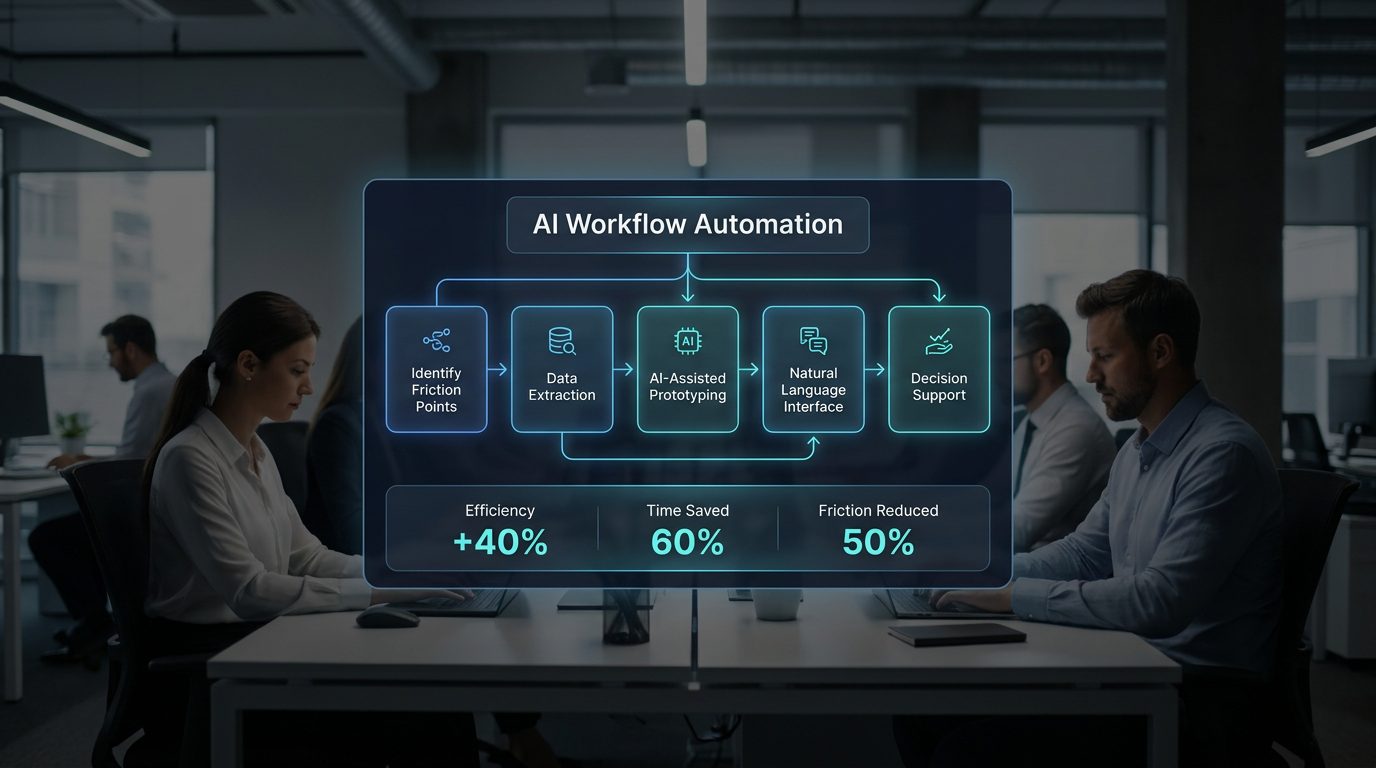
AI Workflow Automation: How Founders Remove Friction Before Replacing Work
AI workflow automation works best when founders stop asking where AI can be added and start asking where work is getting stuck. The highest-value AI opportunities are rarely the flashiest ones. They are usually found in the slow handoffs, manual reviews, repetitive documentation, delayed approvals, scattered customer data, and internal bottlenecks that already frustrate your team.
This matters for agencies, service businesses, healthcare operators, SaaS companies, and founder-led teams because AI is not just a tool category. Used correctly, it becomes a new operating layer across the business.
Key Takeaways
- AI creates more value when it removes friction from existing workflows instead of forcing teams into completely new processes.
- The best automation opportunities usually sit close to the people who experience the problem every day.
- Non-technical team members can now prototype ideas, test workflows, and improve operations faster with AI-assisted systems.
- Natural language is becoming a practical interface for complex tools, data, and internal processes.
- Founders should prioritize measurable workflow improvements before investing in broad AI transformation projects.
The Real AI Opportunity Is Friction, Not Replacement
Many business owners still frame AI around replacement: replacing support agents, replacing analysts, replacing writers, replacing admin staff. That framing misses the more practical opportunity. Most teams do not need AI to replace entire roles. They need AI to remove the unnecessary drag inside those roles.
In healthcare, for example, some of the most useful AI implementations are not built around replacing clinicians. They are focused on reducing administrative burden, helping non-engineers prototype product ideas, extracting information from complex documents, and making legacy systems easier to work with through natural language. That same pattern applies far beyond healthcare.
A marketing agency does not need AI to replace strategists. It may need AI to turn messy discovery notes into structured briefs. A law firm may not need AI to replace attorneys. It may need AI to summarize intake forms, flag missing documents, and prepare first-draft research memos. A B2B services company may not need AI to replace account managers. It may need AI to surface renewal risks from calls, emails, tickets, and CRM notes.
The difference is important. Replacement creates fear and resistance. Friction reduction creates adoption because the team immediately feels the benefit.
Start With the Work Your Team Already Knows Is Broken
Founders often make AI implementation harder than it needs to be by starting with a tool search. They compare platforms, test chatbots, review demos, and ask vendors what AI can do. A better starting point is a workflow map.
Ask your team where work slows down. Where do people copy information from one system into another? Where do clients wait longer than they should? Where does quality depend on one overloaded person? Where do approvals pile up? Where do employees create their own spreadsheets because the official system is too slow or too rigid?
These questions reveal the operational surface area where AI workflow automation can produce measurable value. The best use cases often include:
- Turning unstructured notes into structured project briefs.
- Summarizing long customer conversations and identifying next steps.
- Extracting data from PDFs, emails, intake forms, invoices, or support tickets.
- Drafting internal status updates from project management activity.
- Routing requests to the right team based on intent and priority.
- Creating first-draft reports from multiple business systems.
- Helping managers identify bottlenecks before they become client problems.
None of these examples require a company-wide AI revolution. They require a clear view of the workflow, the right data access, sensible controls, and a practical build process.
Why Non-Technical Teams Should Be Part of AI Design
One of the most important shifts in AI adoption is that non-technical employees can now participate directly in workflow design. Clinicians, product managers, operators, sales leads, account managers, analysts, and customer success teams can describe what they need in plain language, test prototypes, and refine outputs without waiting months for a traditional development cycle.
This does not mean every employee should build production systems on their own. It means the feedback loop between the person who feels the pain and the person who designs the solution can become much shorter.
For founders, this is a major advantage. The people closest to the work usually understand the edge cases better than leadership does. They know which fields are often missing, which client requests cause confusion, which reports are never trusted, and which manual checks prevent mistakes. When these employees are included early, AI systems become more useful and less theoretical.
A practical approach is to run small workflow labs. Choose one process, bring in the people who execute it, document the current steps, identify the slowest points, and prototype an AI-assisted version. The result might be a prompt-based assistant, a structured automation, an internal knowledge tool, or a human-in-the-loop review system.
Natural Language Is Becoming the New Business Interface
Many business systems were designed around forms, filters, dashboards, dropdowns, and rigid navigation. That structure works for clean, predictable tasks. It breaks down when employees need to ask complex questions across messy data.
Natural language changes the interface. Instead of forcing a team member to search through five systems, they can ask: Which open client projects are at risk this week? Which leads have gone cold but still show high intent? Which invoices are missing supporting documentation? Which support tickets mention cancellation risk?
This is where AI workflow automation becomes more than task automation. It becomes an access layer across the business. The AI does not simply generate text. It interprets intent, searches the right sources, organizes context, and gives the user a useful next step.
For agencies, this can be especially valuable. Agency teams often operate across CRMs, project management tools, email, Slack, analytics platforms, ad accounts, and reporting dashboards. A natural language interface can reduce the time spent finding information and increase the time spent making decisions.
Practical Examples for Business Owners
Consider a founder running a 25-person digital agency. The team spends hours each week preparing client reports. Data comes from Google Analytics, ad platforms, CRM exports, call notes, and project updates. Instead of replacing the account team, AI can assemble a first-draft report, flag anomalies, summarize campaign changes, and list recommended discussion points for the next client meeting. The account manager still reviews and owns the final version, but the preparation time drops significantly.
Now consider a healthcare services company with a heavy intake process. Staff manually review forms, insurance details, referral notes, and patient communications. AI can extract key information, identify missing fields, classify urgency, and prepare a structured summary for human review. The goal is not to remove judgment. The goal is to give qualified people cleaner information faster.
Or take a B2B consulting firm. Partners spend too much time reviewing sales calls and preparing proposals. AI can summarize discovery calls, identify pain points, match them to service offerings, draft a proposal outline, and create internal handoff notes for delivery. This improves speed without lowering the importance of expert review.
In each case, AI succeeds because it is attached to a real workflow problem, not because the company bought the newest tool.
How Founders Should Prioritize AI Workflow Automation
Not every workflow should be automated first. Some are too risky, too unclear, or too dependent on poor-quality data. A simple prioritization model helps founders avoid wasted effort.
Score each workflow against five criteria:
- Frequency: Does this process happen often enough to matter?
- Time cost: How many hours are currently spent on it?
- Business impact: Does improving it affect revenue, retention, margin, or customer experience?
- Data readiness: Is the required information accessible, organized, and reliable enough?
- Risk level: Can a human review step manage quality, compliance, or customer impact?
The strongest early use cases are frequent, time-consuming, measurable, and safe to run with human oversight. These create momentum. Once the team sees AI improving real work, larger implementation becomes easier.
Where Prime Solution Media Fits
Prime Solution Media helps founders and business teams turn AI from scattered tool usage into practical operating systems. That means identifying high-friction workflows, designing automation opportunities, building content and operational systems around AI adoption, and helping teams move from experimentation to implementation.
Our approach is not to push AI into every corner of the business. It is to find the places where AI can improve speed, clarity, consistency, and decision-making without creating unnecessary complexity. For agency owners and operators, that often means better client reporting, stronger internal knowledge systems, faster campaign workflows, improved lead handling, and smarter operational visibility.
The goal is simple: build AI systems that support how the business actually works.
Conclusion: Better Questions Lead to Better AI Systems
The most effective AI implementations start with better questions. Instead of asking where AI can be used, founders should ask where their teams are losing time, where information is trapped, where customers wait, where decisions slow down, and where natural language could make complex systems easier to use.
AI workflow automation is not about chasing novelty. It is about removing operational friction from the work your business already depends on. When founders focus there first, AI becomes less of a buzzword and more of a practical growth system.




