
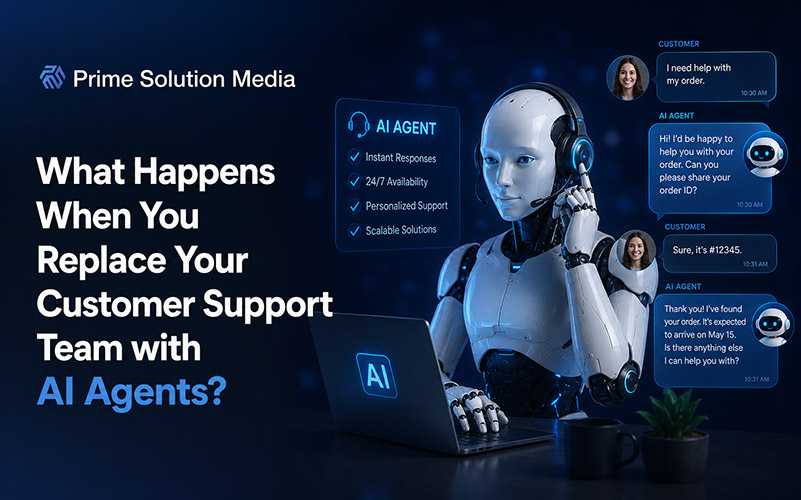
Key Takeaways
- AI handles high-volume, predictable tasks like tracking and FAQs flawlessly 24/7.
- Bots struggle with emotional complaints, complex disputes, and nuanced human judgment.
- Hidden costs include eroded customer trust if human escalation paths are missing.
- Success requires blending fast AI automation with an essential human safety net.
A frustrated customer. A missed message. A review you never saw coming.
That is what pushed businesses toward AI customer support agents, not to cut corners, but because the cracks in traditional support were becoming too costly to ignore. Missed messages, long wait times, agents answering the same question for the fiftieth time that week.
But swapping out a support team, even partially, is not a small call. It changes how customers experience your brand and how your team operates day to day. Done without a clear plan, it creates new problems faster than it solves old ones.
So, what actually happens when you make that shift? Let us walk through it honestly.
Why Are Businesses Moving to AI Customer Support?
The honest answer is not just cost. The bigger driver is volume and consistency. Support teams get flooded, agents get tired, and response quality drops by the end of a long shift. Customers notice.
Automation addresses this well, repetitive, high-volume, low-complexity tasks handled just as reliably at 11 p.m. as at 9 a.m.
Here is what typically pushes businesses toward this shift:
- Response Time Pressure: Customers expect replies within minutes, not hours.
- After-hours Coverage: Human teams cannot cover every time zone without high cost.
- Agent Burnout: Repetitive queries lead to high turnover.
- Scaling Difficulty: Growing companies cannot hire fast enough to match demand.
- Small Business AI Adoption: Smaller teams feel this most, where one person handles everything.
Most companies do not replace everyone overnight. They start with the most predictable interactions and build from there.
What Do AI Customer Support Agents Handle Well, and Where Do They Stumble?
This is where most conversations about AI get either too optimistic or too dismissive. The truth is somewhere more practical.
The Easy Wins
There is a category of support tasks that AI genuinely handles well. These are structured, predictable interactions where the answer is almost always the same.
| Task Type | Why AI Handles It Well |
|---|---|
| Order tracking and status updates | Data is pulled directly from the system, no judgment needed |
| FAQ responses | Standard answers can be pre-built and served instantly |
| Appointment scheduling or changes | Rule-based logic works perfectly here |
| Password resets and account access | Step-by-step process, no emotional complexity involved |
| Basic troubleshooting (step 1, step 2…) | Follows a script that resolves most common issues |
The Messy Situations AI Still Struggles With
Automated customer support AI is trained on patterns. When a situation breaks from the pattern, it tends to fall short.
Scenarios where AI regularly struggles:
- Emotionally Charged Complaints: Angry customers want to feel heard, not scripted.
- Refund Disputes: Not every situation fits neatly into a policy.
- Layered Problems: Billing plus shipping plus a damaged product is too much for rule-based logic.
- Sensitive Topics: Medical queries, legal questions, anything requiring real discretion.
AI is genuinely good at a specific layer of support. Human judgment is still essential for everything above it.
AI vs. Human Customer Service: What Changes for the Customer?
This is the part businesses sometimes overlook when building their support stack. The operational benefits of AI are visible internally. But the customer experience changes in ways that are not always obvious until they show up in your reviews.
Speed Is Not the Same as Care
AI is fast. There is no question about that. A customer asking a simple question gets an answer in seconds. For that type of interaction, speed is the quality of service.
But support is not always about speed. Sometimes a customer is frustrated, confused, or genuinely worried about something. In those moments, what they need is not a faster reply, but someone who actually understands what they are going through.
Human agents pick up on tone, read context, and adjust. They can say “I completely understand why that’s frustrating” and mean it in a way that changes the entire dynamic of the conversation.
Why Some Customers Still Want a Real Person
Research consistently shows that customers are willing to accept AI for simple, transactional interactions. But their tolerance drops sharply when:
- The issue is complex or unresolved after the first response.
- They are dealing with a financial concern or a time-sensitive problem.
- The bot misunderstands them, and they have to repeat themselves.
- There is no clear way to reach a human.
Moving to AI support too quickly, without preserving easy human escalation, is where brands start losing trust. It does not happen all at once. It builds quietly in the background until the reviews start reflecting it.
What Are the Hidden Trade-offs When You Replace Customer Support with AI?
Every business that has made this shift eventually runs into things they did not fully anticipate. Here are the ones worth knowing before you move forward.
When Efficiency Becomes a Problem
Efficiency is the main selling point of AI-driven support. But taken too far, it creates friction of its own.
| What Felt Efficient | What It Actually Did |
|---|---|
| Removing the contact number | Customers who needed help felt stranded |
| Making the escalation path hard to find | Frustration levels spiked before humans got involved |
| Automating responses without reviewing them | Wrong or tone-deaf replies went out at scale |
| Cutting agent headcount too fast | When AI failed, there was no safety net |
Brand Voice, Trust, and Frustration
When you replace customer support with AI without thinking carefully about brand voice, the experience can feel cold. Customers who have been with a brand for years suddenly feel like they are talking to a wall.
AI responses are consistent, which sounds like a positive. But consistently generic is its own problem. Support conversations are one of the most direct touchpoints a brand has with its customers. That moment of contact either builds loyalty or quietly erodes it.
A few things worth watching:
- Does your AI acknowledge the customer’s frustration before jumping to solutions?
- Is there warmth in the language, or does every response feel transactional?
- Can a customer reach a human within two or three interactions if needed?
- These details matter more than most implementation plans account for.
How Can Businesses Use Customer Service Automation Tools Without Losing the Human Touch?
The businesses that get this right do not think of AI as a replacement. They think of it as a first layer, fast, available, and consistent, with human support as the second layer that catches what AI cannot handle.
Start With the Right Tasks
A practical rollout does not start with the hardest problems. It starts with the most predictable ones.
- Identify your top 10 most frequently asked questions and automate those first.
- Build clear escalation rules before going live, not after.
- Set the AI to hand off conversations when it detects frustration signals or repeated questions.
- Review AI responses regularly in the first few months; do not set and forget.
- Keep a small human team available, especially during high-stakes moments like product launches or service disruptions.
Small Business AI Adoption works best at this pace. Phased rollouts let you catch problems while they are still small and adjust before customers feel the impact.
Keep a Clear Handoff to Humans
The handoff moment, when AI passes a conversation to a human agent, is one of the most critical points in the entire experience. A smooth handoff feels invisible to the customer. A clunky one resets the frustration level to zero.
Good handoffs include:
Full Conversation Context Passed to the Agent
No customer should have to repeat themselves.
A Warm Transition Message
Something that acknowledges the wait and sets expectations.
Fast Pickup Times
If the human queue is long, customers need to know that upfront.
The goal is not to hide the AI. It is to make the whole experience feel cared for.
This is also where the broader setup matters. An AI agent on top of a poorly structured website or disconnected systems cannot perform the way it should.
The web development, software development, and digital marketing infrastructure around the AI shapes how well it actually works. At Prime Solution Media, this is the foundation we help businesses get right, starting with AI Automation. Not sure where your setup stands? Let’s talk.
How Prime Solution Media Helps Businesses Handle AI Automation the Smart Way
Most businesses come to us after the fact, after the AI rollout felt clunky, after customers started complaining, after the system that looked good on paper created more confusion than it resolved.
What we have learned is that AI support does not fail because the technology is bad. It fails because the groundwork was rushed.
At Prime Solution Media, we work through the setup before anything goes live: the systems, the workflows, the handoff logic. Because automation built on a solid foundation works. Automation built on a shaky foundation just breaks faster.
Conclusion
Replacing your customer support team with AI agents is not a decision you make once and forget. Done right, AI customer support agents handle the repetitive, high-volume layer, freeing your people for conversations that actually need human judgment. Done poorly, it quietly erodes the trust customers have in your brand.
The businesses getting this right see AI and human support as two parts of the same system. Speed matters. But so does how a customer feels after every interaction. Start that conversation here.
Frequently Asked Questions
Why are businesses moving to AI customer support?
To handle high-volume, repetitive queries consistently 24/7, reducing response times and agent burnout.
What tasks do AI support agents handle best?
Structured, predictable tasks like order tracking, FAQ responses, password resets, and basic troubleshooting steps.
Where do AI customer support agents struggle?
AI struggles with emotionally charged complaints, refund disputes, layered problems, and sensitive topics requiring human discretion.
How do you prevent AI support from ruining customer trust?
Ensure a seamless, instant handoff to human agents whenever the AI detects frustration or complex issues.
How should a business start implementing AI support?
Start with a phased rollout automating your top ten FAQs while keeping a human safety net.




