
Key Takeaways
- AI consultants define strategy, while AI agencies execute technical development.
- Choose a consultant for strategy and an agency for building.
- Full-service agencies bridge the gap between AI planning and execution.
- Consider hidden costs like APIs, hosting, and post-launch maintenance.
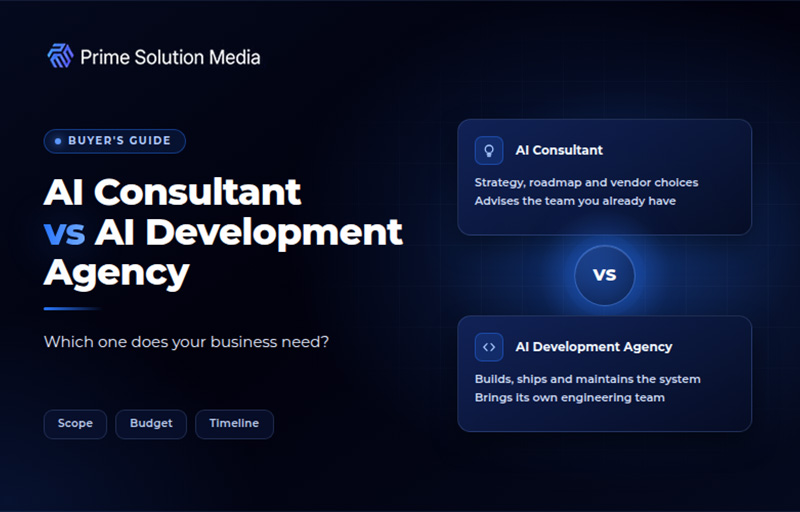
An AI consultant advises while an AI development agency builds. A consultant assesses your business, finds where AI can help, and hands you a strategy and roadmap, which suits you best when you know you want AI but are not sure where to start.
An AI development agency takes a defined plan and actually designs, codes, and deploys the solution, which fits when you already know what you need and want it running. If you are still exploring, start with a consultant; if your use case is clear, go with a development agency. And if you want guidance and delivery without any handoff gaps, choose a partner that does both under one roof.
Choosing who should handle an AI project can feel strangely difficult. You may know that your business needs better automation or a smarter way to handle repetitive work, but the next step is less obvious. Do you hire an AI consultant who can help decide what should happen, or bring in a development agency that can build it?
In most cases, the answer depends on how clear the problem is. An AI consultant can help when you are still figuring out the right use case. An AI development agency makes more sense when you already know what needs to be built. Sometimes, you may need both.
What Does an AI Consultant Actually Do?
An AI consultant usually starts with the business problem rather than the technology.
That distinction matters. It is easy to get excited about a new AI tool and then realize six weeks later that nobody really needed it. A consultant helps prevent that kind of expensive detour by looking at how the business operates today.
When Is Guidance More Useful Than Development?
An AI consultant may help you:
- Review repetitive tasks across departments.
- Identify workflows that could benefit from AI.
- Decide where automation is actually worth the cost.
- Compare AI platforms and software options.
- Build an AI roadmap for the next few months.
- Assess internal technical skills and gaps.
- Review data handling and security requirements.
- Set rules for how AI should be used by employees.
This is where the AI Consultant vs AI Agency discussion gets interesting. A consultant may not spend most of their time writing code. Their job is often to help you make a better decision before the coding begins.
That can be especially useful for a business that has ten possible AI ideas but only the budget to pursue one or two.
What Does an AI Development Agency Bring to the Table?
An AI development agency steps further into execution. Once the business knows what it wants to build, the agency can handle the technical work needed to turn that idea into a working system.
When Do You Need a Team Instead of a Roadmap?
An agency may handle:
- Custom AI applications.
- AI agents for customer or internal workflows.
- API and software integrations.
- AI-powered websites or platforms.
- Voice agents and automated communication.
- Database connections.
- Testing and deployment.
- Ongoing technical maintenance.
For example, a company might know that customer inquiries are taking hours of staff time every week. The business could have a clear goal, such as an AI agent that answers common questions, qualifies leads, and passes complicated requests to an employee.
At that point, advice alone may not be enough. The company needs people who can build the system, connect it to existing tools, test it, and keep it working.
Integration remains a major AI implementation challenge, with 95% of IT leaders in a Deloitte-referenced study citing integration as an obstacle to seamless AI adoption.
This is also where an AI automation company can become useful, especially when the project involves multiple business processes rather than one isolated feature.
AI Consultant vs AI Development Agency: What Is the Real Difference?
The simplest way to look at it is this: a consultant helps answer “What should we do?”, while a development agency is more focused on “How do we build it?”
There is overlap, of course. Some consultants have technical teams. Some agencies provide planning before development. Still, their main strengths can be different.
| Area | AI Consultant | AI Development Agency |
|---|---|---|
| Main role | Planning and guidance | Building and implementation |
| Best starting point | When the problem is still unclear | When the project is clearly defined |
| Typical work | Audits, roadmaps, tool selection | AI systems, agents, integrations |
| Technical execution | May be limited | Usually a major part of the service |
| Team structure | Often one expert or small team | Developers and other technical specialists |
| Ongoing support | Depends on the consultant | Often available after launch |
| Best fit | Businesses exploring AI | Businesses ready to build |
A company with strong developers may only need outside direction. Another company may have a clear idea but no one internally who can build it.
Which Option Fits Your Business Right Now?
This is where the decision becomes much easier. Start with the problem, not the job title.
An AI Consultant May Be the Better Fit When:
- You are not sure where AI belongs in the business.
- Leadership wants a clear AI plan.
- Several departments have possible use cases.
- You need help selecting tools.
- Your company already has developers.
- You want to avoid spending heavily on the wrong project.
- You need an outside view of your current processes.
An AI Development Agency May Be the Better Fit When:
- You already have a specific AI use case.
- You need custom software.
- Several systems need to connect.
- Your internal team does not have the required development skills.
- You need an AI agent, voice agent, or automated workflow built.
- You need technical support after launch.
- The project affects customers or core operations.
There is another option that often gets overlooked. You do not always have to choose one or the other.
A consultant can define the project first, then a technical team can build it. In other cases, one provider can handle both sides. That can reduce handoffs and keep business goals connected to technical decisions.
| Business Situation | A Practical Starting Point | Why |
|---|---|---|
| “We know AI matters, but where do we begin?” | AI Consultant | Helps identify useful opportunities |
| “We need an AI roadmap.” | AI Consultant | Focuses on planning and priorities |
| “We have a working concept that needs to be built.” | Development Agency | Provides technical execution |
| “We need an AI agent connected to our CRM.” | Development Agency | Requires development and integration |
| “We need both planning and implementation.” | Consultant + Agency or Full-Service Team | Covers both business and technical needs |
What About Cost, Time, and Hidden AI Expenses?
Price can make the decision feel simple. Usually, it is not.
An AI consultant may be more cost-effective when you need a short engagement focused on research, planning, or assessment. An agency can cost more because several people may work on the project, especially when development, testing, design, integration, and support are involved.
However, the lower initial fee is not always the lower total cost.
Think about what happens if a business spends money building an AI system that does not fit the workflow. Now there is a second project: fixing the first one. That is where many hidden AI costs can appear.
Before approving a project, ask about:
- Software and API charges.
- Cloud or hosting costs.
- Data preparation.
- Integration work.
- Ongoing maintenance.
- Monitoring and testing.
- Employee training.
- Future changes to the system.
Time matters too. A consultant may help define the project quickly, while development naturally takes longer because there is something physical to build and test.
In other words, do not compare two proposals only by the number at the bottom of the page. Compare what each proposal actually covers.
What Should You Check Before Hiring Either One?
Hiring an AI expert is not only about technical credentials. It is also about whether they understand your business well enough to ask uncomfortable but useful questions.
Ask These Questions Before Signing:
1. Do they understand the business problem?
A good provider should be able to explain the problem in plain language before discussing models, platforms, or software.
2. Who will actually do the work?
Know whether you will work directly with the person you hired or be handed to another team.
3. What happens with your business data?
Ask where data goes, who can access it, and what permissions the system needs. One question worth asking is: how safe is your company data with AI agents?
4. What happens after launch?
AI systems need monitoring. Errors, changing business rules, and software updates can affect performance over time.
5. Can the system grow with the business?
A small internal tool and a customer-facing AI platform have very different requirements.
Also check whether the provider can explain technical limitations honestly. That matters more than hearing that every AI problem has a simple solution.
How Prime Solution Media Can Help You Move from Strategy to Implementation
At Prime Solution Media, we work across both sides of this decision. Our services include AI automation, software development, website development, app development, and business consultation. Our AI automation service also covers custom AI agents, voice agents, workflow automation, testing, deployment, and ongoing support.
That combination can be useful when a business does not want strategy sitting in one document while development happens somewhere else. We start by looking at the workflow and identifying where an AI system makes practical sense. From there, our team can move into design, development, testing, and deployment.
For a company that only needs advice, a consultant may still be the better choice. But when the business needs help deciding what to build and then needs a team to build it, having both capabilities under one roof can simplify the process.
Conclusion: So, Should You Hire a Consultant or an Agency?
The AI Consultant vs AI Development Agency decision becomes much clearer once you stop asking which option is better and start asking what your business needs right now.
An AI consultant is often the better choice when the problem is still unclear; priorities need to be set, or the business already has technical people in-house. A development agency makes more sense when the use case is defined, and the work involves building software, agents, integrations, or automation.
There is no prize for choosing the most technical option. The better choice is the one that solves the actual problem without adding unnecessary cost or complexity.
Before making a decision, write down the problem, the expected result, your internal capabilities, and what you need after launch. Then compare providers against those needs.
Frequently Asked Questions
What is the main difference between an AI consultant and an AI agency?
An AI consultant helps define what AI project to build through planning and strategy, while an AI agency focuses on how to build and deploy it.
Should my business hire an AI consultant or an AI development agency?
Hire an AI consultant if your business goal is unclear. Hire an AI agency when you have a defined project requiring custom software, integration, or coding.
Can an AI development agency also provide AI strategy and planning?
Yes, many full-service AI agencies offer upfront strategy alongside technical execution, helping businesses bridge the gap between initial planning and software deployment.
What are the hidden costs of hiring an AI development agency?
Hidden costs include API fees, cloud hosting, data preparation, system integration, continuous monitoring, post-launch maintenance, and ongoing employee training.
How do I know if my business is ready to build an AI solution?
You are ready if you have a clearly defined problem, mapped workflows, adequate data, and dedicated budget for software development and post-launch maintenance.




