
Key Takeaways
- AI costs include building, running, maintaining, and fixing systems.
- API usage and compute fees scale rapidly with business growth.
- Dirty data and legacy infrastructure dramatically inflate implementation expenses.
- Proposals often hide post-launch retraining, security, and oversight costs.
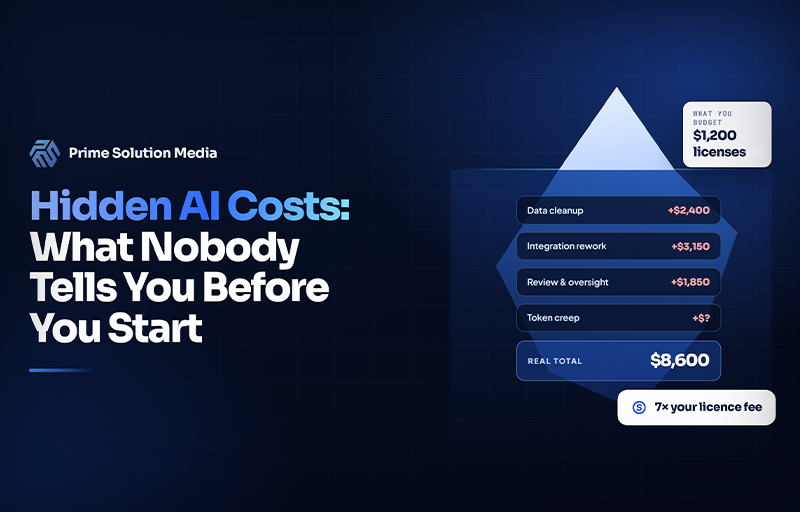
AI adoption costs extend far beyond initial software development. Long-term expenses stem from scaling API usage, cleaning dirty data, continuous model retraining, security compliance, and necessary human oversight for output monitoring.
In fact, 93% of organizations report exceeding their AI budgets as they move from AI experimentation to production.
So, let’s answer the question early: the cost of AI isn’t really one cost. It’s a build cost, a running cost, and a fixing cost, and most conversations only cover the first one. If you’re planning to bring AI into your business, here’s what tends to get left out.
What Are You Actually Paying For?
When someone asks, “How much does AI cost?”, they usually mean the build, the part where a model gets picked, trained, or fine-tuned, and connected to whatever systems already run the business. That part is real, and it’s often the smallest piece of the total.
The AI development cost typically breaks down into a few recognizable stages:
- Discovery and scoping: Figuring out what the AI actually needs to do, and what it shouldn’t try to do.
- Model selection or fine-tuning: Choosing an existing model or training one on your data.
- Integration: Connecting the AI to your CRM, website, support tools, or internal systems.
- Testing: Catching the edge cases before customers do.
Here’s the part that catches people off guard. Two projects that look identical on paper can have very different cost of AI development numbers, because the difference isn’t the technology. It’s how messy the existing data and systems are before the AI ever touches them.
Why Is AI So Expensive? The Line Items Nobody Puts in the Proposal
This is usually where the conversation stalls, because why is AI so expensive isn’t really about the AI itself. It’s about everything sitting underneath it that nobody thinks to mention in a first meeting.
Here’s a rough sense of where the money actually goes once you look past the build:
| Cost Category | What It Covers | What It Covers |
|---|---|---|
| Compute and API usage | Running the model every time it’s used | Yes, scales with traffic |
| Data preparation | Cleaning, labeling, and licensing data | Very often |
| Security and compliance | Access controls, audits, data protection | Almost always |
| Monitoring | Watching for errors, drift, or bad outputs | Frequently |
| Human review | People checking AI decisions before they go live | Often skipped in early quotes |
The same tool handling ten thousand conversations a day is a different budget line entirely, and that shift can happen faster than most teams plan for.
How Much Does AI Cost Once It’s Actually Running?
Here’s something that surprises a lot of founders: the AI doesn’t get finished the day it launches. It needs attention, the same way a new hire needs onboarding and the occasional correction.
This is where the question of how expensive AI is becomes an ongoing one rather than a one-time answer. A few things tend to show up on the bill month after month:
- Retraining or updating the model as your business or customer questions change.
- Fixing outputs that were technically correct but practically useless.
- Paying for downtime when the AI stops working mid-task.
- Adding human oversight for anything sensitive, like billing or medical information.
It’s worth saying plainly: AI agents are replacing manual workflows across every industry, and that shift changes where labor costs go rather than removing them completely. Someone still needs to check the work, especially early on.
| Ongoing Cost | Monthly or One-Time? | Monthly or One-Time? |
|---|---|---|
| Model retraining | Recurring | Development team |
| Error correction | Recurring | Support or QA staff |
| Uptime and reliability fixes | As needed | Engineering |
| Compliance updates | Recurring | Legal or compliance |
The Cost of Vendor Lock-In (Nobody Mentions This Until You’re Already In)
There’s one more cost that rarely comes up in the first conversation, and it’s the cost of leaving. Once an AI system is built into your daily operations, switching providers isn’t as simple as canceling a subscription.
A few things worth checking before you sign anything:
- Data portability: Can you export your data and conversation history, or does it stay locked inside the vendor’s platform?
- Proprietary integrations: Some vendors build tools that only work inside their own ecosystem, so moving means rebuilding from scratch.
- Retraining costs: A new provider often means retraining the model on your data again, which isn’t free.
- Contract pricing tiers: Some agreements quietly increase per-usage pricing as your traffic grows, with no easy exit clause.
None of this means locking in is always bad. Sometimes it’s a fair trade for a lower upfront price. But it’s worth asking about exit costs at the start, not after you’ve outgrown the platform and realized switching costs more than staying.
Generative AI Costs: A Different Beast Entirely
Generative and agentic AI complicate the math even further. Traditional software has a fairly predictable cost structure. You build it once, and running it costs roughly the same every month. Generative AI doesn’t work that way.
The cost of generative AI is tied to how much the model “thinks.” A short customer support reply costs very little. A multi-step agentic AI process, one that searches, reasons, checks a database, and then responds, can cost noticeably more, even though it happens in seconds.
If your business is exploring AI automation for anything beyond simple replies, this is the part worth budgeting for carefully, since usage can climb quietly as the AI gets more capable and more relied upon.
Red Flags in an AI Proposal That Signal Hidden Costs Later
Not every proposal is upfront about what happens after launch. A few patterns tend to show up right before a client gets surprised by their second invoice:
The Quote Only Covers “Build And Deploy”
Ask directly what happens in month two, three, and six.
No Mention of Usage-based Pricing
If the AI runs on tokens or API calls, ask for a range based on expected traffic, not just a flat number.
Vague Answers About Who Fixes Errors
Someone has to review and correct outputs; find out if that’s included or billed separately.
No Plan for Retraining
Models drift over time as customer questions and business needs change, and retraining isn’t automatic.
Pressure To Sign Quickly
A proposal that avoids specifics and pushes for a fast decision is usually hiding a bigger number down the line.
A good proposal answers these questions before you have to ask. If it doesn’t, that’s worth a follow-up call before anything gets signed.
How PSM Helps You Budget for AI the Right Way
We’ve sat across the table from business owners who got quoted for the build and nothing else, and then felt blindsided three months in. So, our approach starts differently. Before writing a line of code, we walk through what a project will actually cost to run, not just to launch.
At Prime Solution Media, we:
- Scope ongoing expenses early so there are zero surprise invoices.
- Right-size automations to match your realistic operational needs.
- Provide post-launch governance instead of disappearing once the build goes live.
If you’re weighing AI agent development services and want a straight answer on what it will cost this year and next, a quick call is the easiest way to get one.
Conclusion
The cost of artificial intelligence isn’t hidden because anyone’s trying to trick you. It’s hidden because most conversations stop at the build, and the build is genuinely the easiest part to price. The harder, more expensive parts show up after launch, in the running, the fixing, and the watching.
That’s really the shift worth making before you start any AI project: stop asking what it costs to launch, and start asking what it costs to keep working well a year from now. The businesses that budget for that upfront rarely get caught off guard later. The ones that don’t usually learn it the hard way, one invoice at a time.
Frequently Asked Questions (FAQs)
Why do most companies exceed their AI budgets after launch?
Initial quotes only cover the build phase. They routinely leave out consumption-based API usage, data pre-processing, security compliance, error monitoring, and human review.
What is the true total cost of AI development and implementation?
It is a three-part total: initial build costs, ongoing infrastructure/API compute fees, and recurring maintenance (data hygiene, system integrations, and retraining).
How much does AI cost to maintain once operational?
Ongoing costs vary by usage, including API call tokens, continuous model retraining, system downtime fixes, and human output monitoring.
What hidden costs should you look for in an AI proposal?
Watch out for flat build-only quotes, omitted token usage fees, unassigned error-fix responsibilities, and missing post-launch retraining plans.
Why are generative and agentic AI models more expensive to run?
Generative AI costs scale directly with reasoning depth; multi-step tasks consume more tokens and API calls than simple replies.




One Comment