
Key Takeaways
- AI agents execute tasks autonomously instead of just answering questions.
- Support, logistics, finance, and marketing are already actively automating.
- Automation eliminates errors, saves hours, and frees up staff.
- Success requires simplifying the process before automating it.
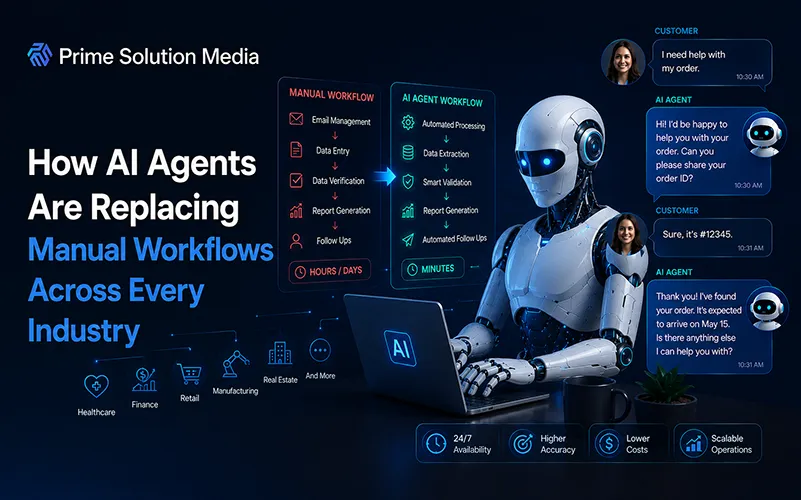
AI agents are transforming business by autonomously executing complex, multi-step workflows across support, finance, and logistics. By replacing slow, error-prone manual tasks, they slash operational costs and free human teams for strategic decision-making.
That is exactly why AI agents replacing manual workflows have become one of the most talked-about shifts in business right now. These systems are quietly taking over the tasks that used to need a person, a login, and thirty minutes nobody had to spare.
Below, we will look at what AI agents actually are, where they are already doing the work, what businesses gain from the switch, and what is worth thinking through before you hand anything over.
What Exactly Is an AI Agent, and Why Is Everyone Talking About Them Now?
An AI agent is not just a chatbot that answers questions. It is a system that can look at information, make a decision, and take an action on its own, without someone sitting there to approve every step. That distinction matters. A chatbot tells you the answer. An AI agent goes and does the thing.
Why the Shift Is Happening Now
A few reasons are lining up at once:
- The language models behind these agents got noticeably better in the past couple of years, which means they can handle messier, less predictable tasks.
- The tools to build them got cheaper and easier to connect to existing software.
- A lot of businesses are just tired of paying skilled people to do repetitive admin work that nobody enjoys.
In fact, 88% of organizations now use AI in at least one business function, highlighting how quickly AI is becoming part of everyday operations.
If you are wondering how AI agents work in business day to day, the short version is this. They read data, apply rules or judgment learned from patterns, and complete tasks such as:
- Replying to a customer.
- Updating a record.
- Flagging something for review.
No manual handoff required.
Where AI Agents Are Already Replacing Manual Work
This is not a future prediction. AI automation across industries is already happening, quietly, in the background of businesses you interact with every day. Here is where it shows up most:
Customer Support
Instead of a rep copying the same answer into ten different tickets, an agent reads the question, checks the account, and responds directly, escalating only the tricky cases.
Operations and Logistics
Inventory checks, reorder triggers, and shipment updates that used to require someone refreshing a dashboard now happen on their own.
Finance and Admin
Invoice matching, expense categorization, and basic reconciliation, tasks that used to take a full afternoon, now run in minutes.
Marketing
Campaign reporting, lead scoring, and follow up sequences get handled without someone manually pulling numbers into a spreadsheet every Monday.
Here is a simple breakdown of what that shift looks like in practice:
| Industry | The Old Manual Way | What the AI Agent Handles Now |
|---|---|---|
| Customer Support | Reps manually search past tickets for answers | Agent pulls context and drafts or sends the reply |
| Logistics | Staff track stock levels by hand | Agent monitors levels and triggers reorders automatically |
| Finance | Someone reconciles invoices line by line | Agent matches invoices to purchase orders and flags mismatches |
| Marketing | Team compiles weekly performance reports manually | Agent generates and distributes the report on its own |
What Businesses Actually Gain from Making the Switch
Time savings get most of the attention, and they are real, but they are not the only reason businesses for AI agents for business automation is picking up speed. A few gains matter just as much:
| What You Gain | What It Actually Looks Like |
|---|---|
| Fewer errors | Agents do not get tired at 4pm on a Friday and skip a step |
| Faster turnaround | Requests get handled in minutes instead of sitting in a queue |
| Lower cost per task | Routine work stops needing a dedicated person to run it |
| Better use of people | Staff spend time on judgment calls, not repetitive data entry |
| Cleaner data | Fewer manual entries means fewer typos and mismatched records |
They catch the customer who is about to churn or the supplier who is slipping on delivery times, because they are not buried in admin work anymore. That is intelligent workflow automation doing its job well: not replacing judgment, just clearing the way for it.
How Prime Solution Media Help Businesses Put This into Practice
Reading about AI agents for operations is one thing. Getting one actually running inside your business, connected to your tools and trained on your process, is a different problem entirely.
At Prime Solution Media, we build AI automation systems for businesses that are past the point of wanting a demo and are ready for something that runs in production.
That usually starts with a plain conversation about where your team is losing the most hours, whether that is customer replies, internal reporting, or scheduling. From there, we build the agent around your actual process, not a generic template.
We noticed most businesses do not need AI everywhere at once. They need one or two workflows handled well, with room to add more once the first one proves itself. If that sounds like where you are, book a call, and we can walk through what business process automation with AI would look like for your team specifically.
A Few Honest Things to Think About Before You Automate Everything
Not every process should be handed off right away, and it is worth saying that plainly. A few things worth sitting with before you start:
- Not every task is repetitive enough to automate well. Some genuinely need human judgment every time.
- Rollout usually takes a bit of trial and error. The first version rarely gets everything right on day one.
- Founders remove friction before replacing work, meaning the fix is often to simplify the process first, then automate what is left.
- Your team needs to trust the system before they will actually rely on it, and that trust takes a few weeks of watching it work.
This is where AI workflow optimization actually matters more than the automation itself. A messy process, automated, is still a messy process. It just runs faster now.
Bringing It All Together
AI agents replacing manual workflows are no longer a trend to watch from a distance. It is already reshaping how customer support, logistics, finance, and marketing teams get their work done, quietly, one process at a time.
The shift is not really about speed either; it is about giving people room to focus on the decisions that actually need a human behind them. Part of that comes down to understanding the difference between an AI agent and an AI chatbot in the first place, since one just answers and the other actually gets the work done.
Most businesses do not need to overhaul everything overnight. Usually, it starts with noticing the one workflow that eats the most time, then talking it through to see what handing it off could look like.
Frequently Asked Questions
What is the main difference between an AI agent and a standard AI chatbot?
Chatbots only answer questions, whereas AI agents autonomously make decisions and execute multi-step workflows across your business applications.
Which business departments benefit the most from replacing manual processes with AI agents?
Customer support, logistics, finance, and marketing gain the most by automating repetitive tasks like reporting, invoicing, and lead follow-ups.
How do AI agents improve operational efficiency and reduce errors in daily workflows?
Agents eliminate manual data-entry typos, operate continuously without fatigue, and instantly process requests that usually take humans several hours.
How does Prime Solution Media help businesses transition from manual work to AI automation?
Prime Solution Media builds custom, production-ready AI agents tailored to your specific tools and time-consuming workflows.
What should a business evaluate before automating a manual workflow with AI?
Businesses must simplify the process first, ensure it requires routine patterns rather than human judgment, and build team trust.




4 Comments