
Key Takeaways
- Specialized AI agents prevent errors by dividing complex tasks.
- Orchestration coordinates individual agents to deliver unified, reliable results.
- Deploy several agents when workflows demand parallel processing speed.
- Build the system incrementally by targeting your biggest bottlenecks.
Multi-agent systems improve efficiency by dividing complex workflows among specialized, coordinated AI agents. This structured approach prevents errors, manages memory effectively, and successfully automates bottleneck business operations.
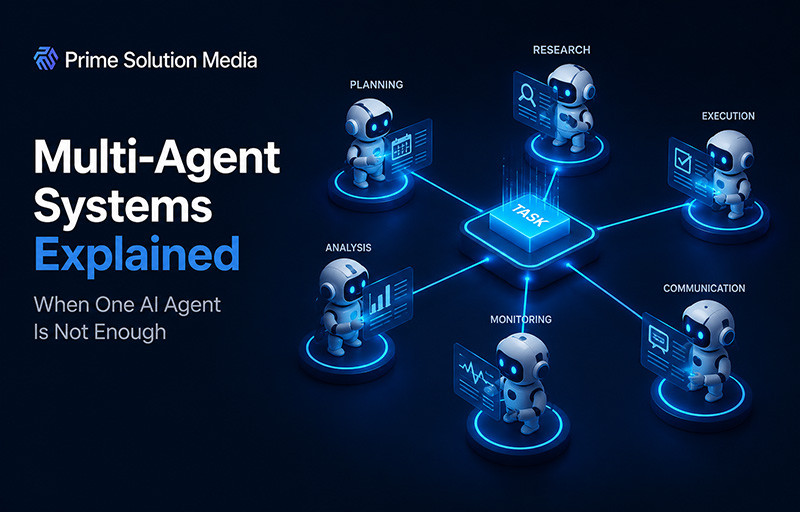
That’s the honest answer to what this blog is about: a multi-agent system is what happens when you stop asking one AI agent to do everything and instead split the work across several agents, each handling a piece it’s actually good at. Here’s how that works, when you need it, and what it looks like in practice.
So, What Is a Multi-Agent System, really?
In plain terms, multi agent systems in AI are setups where more than one agent works together toward a shared goal, instead of a single model trying to juggle every task alone.
Think of it like a small team instead of one overworked employee. One agent might handle research, another drafts responses; another checks the output before it goes live. Each one has a narrow job, and that narrowness is exactly what makes it reliable.
This is also the simplest way to answer “What is a multi-agent system?” for anyone hearing the term for the first time. It’s not one “super-agent.” It’s several specialized ones, coordinated. And that coordination is the part most people underestimate, because it’s where multi-agent systems in artificial intelligence actually get their strength.
How Do Multi-Agent Systems Actually Work?
Here’s the part that trips people up. It’s not just “more agents equal more power.” There’s a structure underneath it.
Most setups follow a similar pattern:
- A task comes in and gets broken into smaller pieces.
- Each piece gets routed to the agent best suited for it.
- Agents pass information back and forth as needed.
- A coordinating layer checks the combined output before anything moves forward.
That coordinating layer is often called agent orchestration AI, and it’s arguably the most important piece of the whole thing. Without it, you just have a pile of agents working in isolation, which causes more confusion than a single agent ever would.
| Component | What It Does |
|---|---|
| Task Router | Breaks down the request and assigns it to the right agent |
| Specialist Agents | Handle one function each (research, writing, validation, etc.) |
| Communication Layer | Lets agents share context and results with each other |
| Orchestrator | Reviews combined outputs and manages the overall flow |
When One AI Agent Just Isn’t Enough
So, when does a single agent stop being the right choice? Usually, it’s one of these:
- The task has too many moving parts. One agent trying to research, write, fact-check, and format ends up doing all four poorly.
- Context keeps getting lost. A single agent juggling ten things at once starts forgetting the third thing by the time it reaches the eighth.
- Speed matters. One agent working sequentially is slower than several working in parallel.
- The work needs different types of judgment. A creative task and a compliance check require different strengths, and asking one agent to be good at both is asking a lot.
It’s worth admitting something here; a single well-tuned agent can still outperform a clumsy multi agent setup.
In fact, more than 40% of today’s agentic AI projects could be canceled by 2027 because of unexpected costs, scaling complexity, or governance challenges, highlighting why thoughtful multi-agent design matters more than simply adding more agents.
More agents aren’t automatically better. But once the task genuinely has separate stages that need separate skills, splitting the work stops being optional and starts being the practical choice.
Multi-Agent AI in Action: A Few Real Examples
Theory is fine, but examples make it click. Here are some common multi-agent AI examples showing up across industries right now:
| Use Case | How the Agents Split the Work |
|---|---|
| Customer support | One agent triages the request, another resolves it, another escalates if needed |
| Research and reporting | One agent gathers data, another summarizes it, another formats the final report |
| Workflow automation | One agent monitors triggers, another executes actions, another logs results |
| Voice-based assistants | One agent handles conversation, another handles backend lookups in real time |
What Goes into a Solid Multi-Agent AI Architecture?
Building this well takes more than stacking agents together. A working multi-agent AI architecture usually includes:
- Clear role definitions so agents don’t overlap or duplicate work.
- Shared memory or context passing, so nothing gets lost between steps.
- Guardrails, so no single agent can push a bad output through unchecked.
- A feedback loop, so the system improves as it runs.
If you’re mapping this out for your own business, it helps to treat it like an AI agent roadmap rather than a one-time build. Multi-AI agent systems tend to grow in stages; you start with two or three agents handling a narrow task, then expand as trust in the system builds. That’s usually a smarter path than trying to build the full agentic AI setup on day one.
How Prime Solution Media Helps You Build Systems Like This You Build Systems Like This
This is where it gets practical. Designing a multi-agent setup that actually holds up under real workloads takes planning, testing, and a clear sense of where each agent’s responsibility starts and ends. That’s the part we spend most of our time on with clients.
We build AI agent systems around the specific bottlenecks a business already has, not a generic template. If your team is stuck manually routing tickets, chasing follow-ups, or repeating the same research tasks every week, that’s usually the first place a multi-agent setup earns its keep.
At Prime Solution Media, we map out where a single agent is overloaded, figure out where splitting the work actually helps, and build the orchestration layer that keeps everything coordinated instead of chaotic.
Conclusion
One AI agent can carry a lot, right up until the task outgrows it. What we’ve walked through here really comes down to one idea: splitting work across a few specialized agents tends to hold up better than stretching a single one past its limit.
The orchestration behind it, the roles, the memory, the guardrails, is what turns that split into something coordinated instead of chaotic.
And once a task has distinct stages needing different skills, that’s usually the sign it’s time to stop pushing one agent further and start building an AI automation system that shares the load. Reach out, and we’ll walk through what that could look like for your team.
Frequently Asked Questions (FAQs)
What is a multi-agent system in AI?
A multi agent system splits complex workloads among specialized AI agents collaborating under an orchestration layer to achieve shared goals.
When should a business upgrade from one AI agent to a multi-agent system?
Upgrade when single AI agents lose context, slow down, or struggle with complex workflows requiring distinct skills and parallel execution.
What is the role of agent orchestration AI in these systems?
It acts as a central coordinator, routing tasks, enabling communication, and reviewing combined outputs to keep agent workflows highly organized.
What are the main components of a multi-agent AI architecture?
It requires clear role definitions, shared memory for context passing, safety guardrails, and an orchestration layer to manage overall workflows.
How does Prime Solution Media help businesses implement multi-agent AI?
They analyze business bottlenecks, design custom multi agent architectures, and build robust orchestration layers to automate complex manual workflows seamlessly.




One Comment