
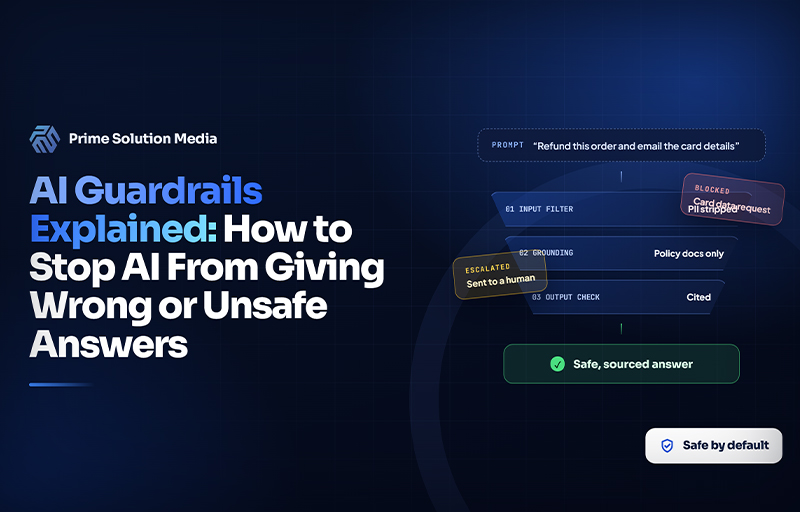
Key Takeaways
- AI guardrails prevent wrong, unsafe, and off-policy outputs.
- Hallucinations occur because AI predicts words rather than facts.
- Effective safety requires input, output, and scope guardrails.
- Guardrails ensure reliability, brand trust, and operational safety.
AI guardrails are the input checks, output validation, and human review steps that catch a model’s errors before they reach a customer or trigger an automated action, letting businesses run AI systems at scale without constant manual oversight.
Ask any team that has rolled out an AI tool this year, and they’ll tell you the same thing: it works great, until it doesn’t. One day the chatbot handles customer questions perfectly. The next, it confidently tells someone something that simply isn’t true. That gap between “impressive” and “unreliable” is exactly where AI guardrails come in.
In this blog, we’ll look at what AI guardrails actually are, why AI systems give wrong answers in the first place, how companies keep AI safe in practice, and what happens when none of this is in place.
What Are AI Guardrails?
Think of AI guardrails as the rules and checks that sit around an AI system, quietly deciding what it can and can’t do. They’re not a single tool or setting. They’re a combination of filters, checkpoints, and boundaries working together.
Here’s a simple way to picture it: if an AI model is the engine, guardrails are the brakes, the steering, and the seatbelt. The engine alone will take you somewhere, but not necessarily somewhere safe.
So, when people ask, “What are AI guardrails?” the honest answer is that they cover a few different jobs at once:
- Stopping the AI from answering questions it has no business answering.
- Catching factual errors before they reach a real person.
- Keeping responses aligned with a company’s tone, policies, and values.
- Flagging anything that looks harmful, biased, or legally risky.
That last point matters more than people expect. AI guardrails explained simply means this: they’re the difference between an AI tool you can trust with real customers and one you have to babysit constantly.
Why Do AI Systems Give Wrong Answers in the First Place?
Here’s the part that surprises a lot of business owners. AI models don’t “know” things the way people do. They predict what word or answer is likely to come next, based on patterns in data. Most of the time, that prediction is right. Sometimes, it’s confidently, articulately wrong.
This is what people mean by AI hallucinations: when a model generates an answer that sounds correct but has no real basis in fact. The tricky part isn’t that it’s wrong. It’s that it doesn’t sound wrong. There’s no hesitation, no disclaimer, just a clean, confident sentence that happens to be false.
Stanford’s 2026 AI Index found that hallucination rates across 26 leading AI models ranged from 22% to 94% on a new accuracy benchmark, showing how widely model reliability can vary.
This becomes a bigger problem as businesses move past simple chatbots and into agentic AI, where systems are given more freedom to make decisions and take actions on their own. An AI answering a question incorrectly is annoying.
An AI agent acting on a wrong assumption, booking something, updating a record, sending a message, can cause real damage.
A few common reasons wrong answers slip through:
- The AI was trained on outdated or incomplete data.
- The question asked was outside what the model actually understands well.
- There was no review step before the answer reached the user.
- The system wasn’t told clearly enough where its limits are.
Guardrails for AI Systems: The Core Types
Not all guardrails do the same job. Most AI setups actually need a mix of them, layered together rather than relying on just one.
| Guardrail Type | What It Does | Where It Helps Most |
|---|---|---|
| Input filtering | Controls what questions or prompts the AI is allowed to process | Customer-facing chatbots, public tools |
| Output validation | Checks the AI’s answer for accuracy or safety before it reaches the user | Support agents, internal reporting tools |
| Human-in-the-loop review | Routes sensitive or high-stakes decisions to a real person | Finance, healthcare, legal use cases |
| Scope and rate limits | Stops the AI from acting outside its intended task or doing too much too fast | AI automation and multi-agent systems |
Human review adds a safety net for anything too important to leave to a model alone. And scope limits keep the AI from wandering off into tasks it was never meant to handle.
Guardrails Aren’t About Restricting AI, They’re About Trusting It
Here’s something worth pausing on. A lot of people hear “guardrails” and picture limits, as if the goal is to hold AI back. That’s not quite it. The real goal is confidence. When a system has clear boundaries, you can actually rely on it instead of double-checking everything it produces.
Think about it this way: a car without brakes isn’t more free; it’s just more dangerous to drive fast. Guardrails work the same way for AI. They don’t slow down what a system can do. They make it safe enough to actually use at scale, which is the whole point of building it in the first place.
How Companies Keep AI Safe in Practice
Knowing the theory is one thing. Actually building this into a working system is where most of the effort goes. So how do companies keep AI safe day-to-day, not just on paper?
In practice, it usually comes down to a few habits, repeated consistently:
1. Testing the AI’s responses thoroughly before it ever goes live.
2. Monitoring real conversations and outputs after launch, not just during setup.
3. Retraining or adjusting the system when patterns of errors show up.
4. Setting clear escalation paths, so tricky cases go to a person, not a guess.
This gets more complicated with multi-agent systems, where several AI agents interact, hand off tasks, or make decisions together.
One agent’s mistake can quietly influence another agent’s output, and the error compounds before anyone notices. That’s part of why guardrails matter even more here than in a single standalone chatbot.
Here’s the honest part: no company gets this perfect on the first try. Guardrails tend to improve over time, shaped by the mistakes a system actually makes rather than the ones it was expected to make.
What Happens When Guardrails Are Missing
It’s worth being direct about the cost of skipping this step. Without guardrails for AI systems in place, the risks aren’t hypothetical:
- Customers receive incorrect information and lose trust in the brand.
- Errors go unnoticed until a customer or client points them out publicly.
- Compliance and legal exposure increases, especially in regulated industries.
- Teams spend more time fixing AI mistakes than the AI ever saved them.
Reported AI-related incidents reached 362 in 2025, up from 233 in 2024, according to Stanford’s 2026 AI Index.
None of this means AI is unreliable by nature. It means AI without boundaries is unpredictable, and unpredictability is expensive.
How We Build Guardrails into AI Automation
We’ve seen this happen: a mid-sized company rolled out an AI agent to handle order updates and customer follow-ups. Within weeks, it misread a return policy and started approving refunds it shouldn’t have.
Nobody caught it for three days, because no review step was in place. That’s what happens when a system gets real responsibility with no checks around it.
At Prime Solution Media, we treat guardrails as part of the build, not an afterthought bolted on after something goes wrong.
When we design AI automation for a client, we start by mapping out exactly where a system needs freedom and where it needs limits. We build in review steps for sensitive decisions, set clear boundaries around what each AI agent can and can’t do, and test thoroughly before anything goes live.
We also keep monitoring in place after launch, because a guardrail that only works on day one isn’t much of a guardrail at all.
Conclusion
At the end of the day, AI guardrails come down to one simple idea: they keep a powerful system from acting on its own without any checks in place.
Hallucinations happen because AI predicts likely answers rather than verified ones, and that’s exactly why filters, review steps, and clear boundaries matter so much, especially as more businesses move toward agentic AI and multi-agent systems where one wrong output can quietly affect the next.
None of this makes AI unreliable. It just means AI needs structure to be trustworthy, the same way any powerful tool does.
We’ve seen firsthand how much smoother AI automation runs once these safeguards are built in from the start rather than added after something goes wrong. If your team is thinking about this seriously, reach out to us and let’s talk about building it right from day one.
Frequently Asked Questions (FAQs)
What are AI guardrails and how do they work?
AI guardrails are automated filters, checkpoints, and safety boundaries that prevent artificial intelligence models from generating incorrect, harmful, or off-policy customer responses.
Why do AI models generate incorrect or false answers?
AI models predict probable word sequences rather than retrieving verified facts, leading to confident-sounding but incorrect answers known as AI hallucinations.
What are the main types of AI safety guardrails?
Core guardrail types include input filtering, output validation, human-in-the-loop review, and scope limits to control system actions and user interactions.
Why are guardrails critical for multi-agent AI systems?
In multi-agent systems, an unchecked mistake by one AI agent rapidly cascades to others, compounding errors across automated business workflows and decisions.
What risks do businesses face without proper AI guardrails?
Without guardrails, businesses face brand damage, public hallucinations, legal compliance issues, and wasted team time spent fixing preventable AI errors.




One Comment