
Key Takeaways
- AI hallucinations occur because models predict text rather than verify truth.
- Fabricated AI outputs appear authoritative, making human verification critical.
- LLMs generate two hallucination types: intrinsic and extrinsic.
- Prevent hallucination risks by grounding AI in verified business data.
AI hallucinations occur when language models predict plausible text instead of verifying facts. Prevent fabricated statistics, fake citations, and business risks by grounding AI in verified data with human oversight.
That moment catches almost everyone off guard the first time it happens. It’s called an AI hallucination, and it’s one of the most talked-about problems in AI right now.
This blog breaks down what AI hallucinations actually are, why they happen, and what you can realistically do about them, whether you’re building with AI or just trying to trust what it tells you.
So, What Exactly Are AI Hallucinations?
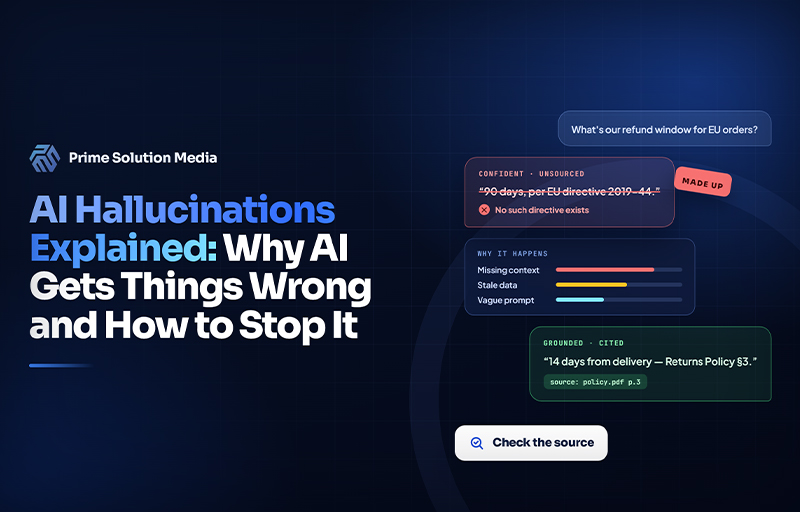
Here’s the simplest way to think about it. AI hallucinations happen when a model generates information that sounds correct but has no basis in fact or in the data it was trained on. The hallucination meaning isn’t about the AI “seeing things” the way a person might. It’s closer to guessing with confidence.
Think about a student who didn’t finish the reading but still has to answer the exam question. They don’t leave it blank. They write something plausible, in the right tone, using the right vocabulary, hoping it lands close enough to correct. That’s essentially what’s happening when you see hallucinations in AI output.
A few common forms this takes:
- Made-up statistics that look precise but trace back to nothing.
- Fake citations, complete with author names and publication dates.
- Confidently wrong summaries of real documents.
- Invented product features, policies, or legal details.
- Fabricated quotes attributed to real people.
None of this is the AI being dishonest on purpose. It doesn’t know the difference between something it learned and something it’s improvising.
Why Do LLMs Hallucinate in the First Place?
This is the part most people skip past, but it’s worth slowing down for, because once you understand it, hallucinations stop feeling random.
Large language models don’t store facts the way a database does. They predict the next most likely word based on patterns learned from massive amounts of text. Most of the time, that prediction lines up with reality because reality shows up so often in the training data. But sometimes the most statistically likely answer just isn’t the true one, and the model has no built-in way to know that.
There are a few forces working together here:
| Cause | What’s Actually Happening |
|---|---|
| Training data gaps | The model never saw reliable information on that specific topic |
| Pattern over fact | The model prioritizes what sounds fluent over what’s verified |
| No real time fact-checking | Most models can’t check themselves against a live source unless connected to one |
| Pressure to answer | The model is built to respond, not to say “I don’t know” |
| Ambiguous prompts | A vague question invites a vague, sometimes invented, answer |
Hallucinations in LLM systems tend to increase with longer, more open ended responses too. The further the model gets from your original question, the more room there is for it to drift into invented territory.
A ChatGPT Hallucination Example You’ll Recognize
Here’s one that shows up constantly. Someone asks ChatGPT to summarize a legal case or academic paper, and it responds with a clean, well-written summary, complete with a citation. The formatting looks right. The tone sounds right.
Except the case doesn’t exist. Or it does exist, but the summary describes an outcome that never happened.
In fact, research found that 44% of hallucinations identified in AI-generated clinical summaries were classified as major because they could affect patient diagnosis or treatment if left unchecked.
This exact pattern made headlines when lawyers submitted legal filings containing fabricated case citations generated by AI, only to have a judge point out that the cases simply weren’t real. It wasn’t laziness. It was trust placed in an answer that sounded authoritative.
That’s really the core danger with any ChatGPT hallucination example. The output doesn’t come with a warning label. It reads exactly like a correct answer would.
Two Kinds of Hallucinations Worth Telling Apart
Not every hallucination looks the same, and it helps to know the difference. Some are intrinsic, meaning the AI directly contradicts something in the source material you gave it, like misreading a contract clause. Others are extrinsic, where the model adds information that was never in the source at all, invented from thin air.
The first type is usually easier to catch, since you can compare it against the original document. The second is trickier. It reads smoothly, fits the context, and gives you no obvious reason to question it until you actually go looking.
Why This Actually Matters for Your Business
It’s easy to treat this as a minor annoyance until it isn’t. If your business is using an AI agent or AI chatbot to handle customer questions, draft contracts, summarize reports, or generate marketing copy, a single confident but wrong answer can create real damage.
Wrong pricing information sent to a customer. A fabricated policy quoted in a support chat. A statistic in a client report that turns out to be invented.
The businesses getting real value from AI right now aren’t the ones avoiding it out of caution. They’re the ones building AI workflow optimization around a simple principle: let AI handle speed and drafting, but keep verification in human hands for anything customer-facing or high stakes.
A few areas where this shows up most:
- Customer support chatbots quoting policies that don’t match reality.
- Sales or marketing content citing invented data points.
- Internal reports summarizing documents inaccurately.
- Legal or compliance content referencing sources that don’t exist.
How to Reduce (and catch) AI Hallucinations
There isn’t a single fix that makes hallucinations disappear completely, and it’s worth being honest about that upfront. What actually works is layering a few habits and safeguards together.
| Strategy | Why It Helps |
|---|---|
| Ground responses in your own verified data | Reduces reliance on the model’s general training guesses |
| Ask for sources, then check them | Forces the model to show its reasoning, which is easier to catch when it’s wrong |
| Break big questions into smaller ones | Vague, broad prompts invite vague, invented answers |
| Keep a human review step for anything public-facing | Catches errors before a customer or client ever sees them |
| Use retrieval based tools over general chat | Pulls answers from real documents instead of pure prediction |
| Re-ask the same question a different way | Inconsistent answers are often a sign of a hallucination |
How Prime Solution Media Helps You Get AI Right
This is where a lot of teams get stuck. They know AI can save time, but they’ve been burned once by an answer that sounded right and wasn’t, so they either avoid it entirely or use it without any real safety net.
At Prime Solution Media, we build AI Automation systems with that exact problem in mind. Rather than plugging in a generic chatbot and hoping for the best, we set up workflows that pull from your actual business data, add review checkpoints where they matter, and keep humans in the loop for anything sensitive.
We’ve noticed that most hallucination problems come from AI being deployed without guardrails, not from AI itself being unusable. The fix usually isn’t less AI; it’s better structure around it.
Conclusion
AI hallucinations aren’t a sign that the technology is broken. They’re a reminder that AI predicts language; it doesn’t verify truth, and that distinction matters more the more you rely on it.
Once you see hallucinations for what they actually are, a byproduct of prediction rather than some rare malfunction, they stop feeling unpredictable. You start noticing where they’re more likely to show up and why.
That shift in perspective is really the whole point. AI isn’t something you either trust completely or avoid out of caution. It’s a tool that works best when you understand its limits as clearly as its strengths.
The teams getting the most out of it aren’t the ones who never question an answer; they’re the ones who’ve built the habit of checking before they commit. That habit, more than any single fix, is what separates AI that quietly causes problems from AI that actually earns its place in how you work.
Frequently Asked Questions (FAQs)
What is an AI hallucination?
An AI hallucination occurs when a language model generates plausible-sounding text that is factually incorrect, unverified, or entirely fabricated.
Why do LLMs generate fake information?
LLMs predict statistically likely word sequences based on patterns rather than retrieving verified facts, leading to confident, ungrounded guesses.
What is the difference between intrinsic and extrinsic hallucinations?
Intrinsic hallucinations directly contradict provided source documents, while extrinsic hallucinations introduce non-existent, fabricated information out of nowhere.
How can businesses prevent AI hallucinations in workflows?
Ground AI models in verified internal data, use retrieval-based search tools, and maintain human-in-the-loop oversight for high-stakes decisions.
How does Prime Solution Media address AI inaccuracies?
How does Prime Solution Media address AI inaccuracies?




2 Comments