
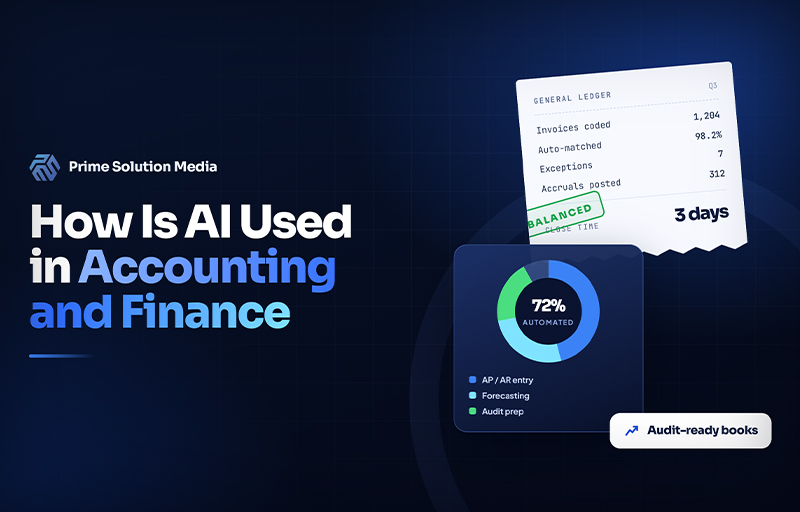
AI in accounting now touches almost every stage of the finance function, from reading invoices to flagging fraud before it hits the books. In 2026, firms use AI in accounting and finance for reconciliation, forecasting, tax prep, and audit support, not just chatbots that answer basic questions. Growing adoption of AI in finance and accounting means most teams already run at least one of these tools without thinking of it as “AI” at all. This guide breaks down the real use cases, the tools finance teams actually run, and where human judgment still has to step in.
Key Takeaways
- AI in accounting now handles reconciliation, anomaly detection, and continuous close, not just data entry.
- Adoption is mainstream: more than half of accounting professionals already use AI tools in daily work.
- AI in accounting and auditing shifts sampling-based reviews toward full-population transaction testing.
- Tools like QuickBooks, Xero, Vic.ai, and BlackLine now build AI directly into their core workflows.
- Human review still catches what models miss. AI adoption without oversight creates new risk, not less risk.
- Firms that pair AI with clear governance see the strongest ROI; firms that bolt it on without a plan often don’t.
A spreadsheet full of formula errors used to cost a controller a sleepless night. Now it can cost a company its quarterly numbers, its investor trust, and sometimes its compliance standing, all before anyone notices the mistake. Manual bookkeeping still breaks under pressure. Invoices get miscoded. Reconciliations slip. Fraud hides in plain sight inside thousands of transaction lines nobody has time to review by hand.
That’s the old story. The new one looks different. AI in accounting has moved from a buzzword on a vendor slide to a working part of daily finance operations. Firms use it to close the books faster, catch fraud earlier, and free up accountants for work that actually needs a human brain. This piece walks through how is AI used in accounting and finance right now, which tools are worth a look, and where the technology still needs a person watching over it.
Who This Guide Is For
This guide speaks to controllers, CFOs, accounting firm partners, bookkeepers, and finance operations leads who keep hearing about AI in accounting and finance but need a grounded picture, not a sales pitch. If you manage a close process, an audit engagement, or a finance team’s tech stack, the use cases below map directly to your week.
What “AI in Accounting” Actually Means Today
Artificial intelligence in accounting isn’t one tool. It’s a layer of machine learning, natural language processing, and pattern recognition sitting underneath tasks that used to require a person clicking through spreadsheets line by line.
Some firms use it lightly. They automate invoice capture or auto-categorize expenses. Others push further, running predictive models for cash flow or letting AI flag anomalies across an entire general ledger in real time. The gap between those two groups is wide, and it’s growing.
Sage’s CTO recently pointed to six use cases now running at production scale across finance teams: continuous analytics, anomaly detection, continuous security monitoring, recommender systems, process automation, and conversational bots. None of these sit in an experimental settings menu anymore. They run the daily close, and they signal how far AI in finance and accounting has moved past the pilot stage.
According to Capterra’s 2026 survey of accounting managers, 53% of accountants now use AI tools built into accounting software, and chatbots, data entry, and fraud detection top the list of common use cases.
How Is AI Used in Accounting and Finance Right Now
Here’s where the technology actually shows up on a finance team’s calendar.
Bookkeeping and Data Entry
AI in accounting starts with the boring stuff, and that’s exactly the point. Document AI tools extract line items from invoices, receipts, and bank statements without a person retyping numbers. Optical character recognition paired with machine learning now reads messy scanned receipts almost as well as a person would, and it doesn’t get tired at 4 pm on close day.
Reconciliation and the Close Process
Matching transactions across bank feeds, ledgers, and subledgers used to eat days. AI-driven reconciliation tools now match thousands of line items in minutes and flag only the exceptions for human review. Some teams have shortened a five-day close to two.
Fraud Detection and Risk Scoring
Rule-based fraud checks catch what you already know to look for. Machine learning models catch patterns nobody thought to write a rule for. AI in accounting and auditing tools score transactions in real time, comparing them against historical behavior and flagging outliers before month-end, not after.
Cash Flow Forecasting and FP&A
Forecasting used to mean a finance analyst building assumptions into a spreadsheet and hoping the quarter cooperated. Predictive models now pull in seasonality, receivables aging, and macro signals to generate rolling forecasts that update automatically. Finance leaders report faster decision cycles as a direct result.
Tax Preparation and Compliance
Tax software has quietly gotten smarter. AI flags deduction opportunities, checks filings against changing regulations, and cross-references prior-year returns for inconsistencies. It doesn’t replace a tax professional’s judgment, but it does cut the hours spent hunting for missing documentation.
Financial Reporting and Narrative Generation
Some platforms now draft the plain-language commentary that goes alongside a financial report, summarizing variance and trend data automatically. A human still edits and approves it, but the first draft takes minutes instead of an afternoon.
AI in Accounting and Auditing: A Closer Look
Audit work has changed more than almost any other corner of the profession. Traditional audits relied on sampling because reviewing every transaction by hand simply wasn’t feasible. AI in accounting and auditing removes that constraint.
Auditors can now test entire transaction populations instead of a sample slice. Contract analysis tools review thousands of agreements for compliance flags in a fraction of the time a legal or audit team would need manually. Anomaly detection guides auditors straight to the transactions worth a closer look, instead of asking them to comb through everything equally.
This doesn’t eliminate audit risk. It redistributes where auditors spend their attention, toward interpretation and judgment calls rather than data collection. That shift matters for firms managing tight engagement timelines during busy season.
Top AI Tools Finance Teams Are Actually Using in 2026
Not every tool fits every team. Here’s a realistic look at what’s in active use, grouped loosely by function.
- QuickBooks Online and Xero both now bundle AI-driven categorization, anomaly flags, and cash flow projections directly into their core plans, which makes them a common starting point for small businesses.
- Vic.ai and Booke.ai focus almost entirely on accounts payable automation, reading invoices and learning coding patterns from historical approvals.
- BlackLine and Trullion handle reconciliation, close management, and lease accounting for mid-size and enterprise finance teams that need audit trails baked into every automated step.
- MindBridge built its reputation on anomaly detection for auditors, scoring risk across entire transaction populations rather than samples.
- Datarails and Vena pull financial data into Excel-based FP&A models, which matters for teams that aren’t ready to abandon spreadsheets entirely.
- Some firms skip off-the-shelf tools altogether and build custom AI systems tied directly into their ERP. That route costs more upfront but fits teams with workflows no packaged tool quite covers; our breakdown of what it actually costs to build a custom AI solution walks through real pricing ranges.
The tool landscape keeps shifting fast, and a platform that’s a great fit today can lag behind a competitor within a year. Test before committing to an annual contract. Most vendors in this space now market themselves around AI in accounting and finance somewhere on their homepage, so read past the marketing language and check what the tool actually automates.
Where Artificial Intelligence in Accounting Still Gets It Wrong
No vendor will lead with this, so it’s worth saying plainly. AI in accounting still makes mistakes, and some of them are expensive.
Language models can generate plausible-sounding numbers that simply aren’t accurate. This isn’t a rare glitch. It’s a known behavior of how these systems predict outputs, and finance teams that treat AI-generated figures as gospel eventually get burned. Our piece on why AI hallucinations happen and how to catch them explains the mechanics in more depth.
A few other friction points show up repeatedly:
- Data quality problems get amplified, not fixed. Dirty legacy data feeding a model produces confidently wrong outputs.
- Security risk climbs when sensitive financial data flows into AI tools without clear guardrails. Over half of finance teams report a data breach at some point, and fewer than half have written policies on what financial information staff can enter into AI systems.
- Regulatory pressure is building. With the EU AI Act and growing SEC attention, 2026 accounting trends point toward “audit-ready AI“, systems that can explain their own decisions rather than acting as a black box.
- Staff still need to review outputs. Most accounting professionals using AI report positive ROI, but nearly all say human checks remain necessary because errors still happen often enough to matter. Firms weighing whether to build agents instead of relying on single tools should read up on what happens when AI agents replace manual workflows before making that call.
None of this argues against adoption. It argues for building AI in finance and accounting workflows with oversight baked in from day one, not bolted on after something breaks. A written governance policy matters more here than most teams expect; our guide on AI governance for growing businesses covers what that policy should actually include.
Getting Started Without Overcomplicating It
Teams that succeed with AI in accounting rarely start with the flashiest tool. They start with the most annoying task.
- Pick one repetitive, high-volume process first, like invoice coding or bank reconciliation.
- Keep a human reviewing outputs for the first several cycles before trusting the tool fully.
- Write down which data can and cannot enter an AI system before staff start experimenting on their own.
- Track hours saved and error rates, not just “we adopted AI,” so leadership sees real numbers.
- Revisit the tool stack every year. What worked in 2025 may already lag behind newer options.
Some firms go further and deploy multi-agent systems that coordinate several finance workflows at once, from data collection through anomaly review. If that’s on your roadmap, it’s worth understanding how agentic AI differs from a simple chatbot before committing budget to it.
Frequently Asked Questions (FAQs)
How is AI used in accounting and finance for small businesses specifically?
Small businesses mostly use AI in accounting through their existing software, like QuickBooks or Xero, for expense categorization, invoice capture, and basic cash flow projections. Few small teams build custom AI systems; most rely on features already built into tools they use daily.
Is AI replacing accountants?
Not based on current data. AI in accounting handles repetitive, high-volume tasks, but firms still report staffing shortages and continue hiring. The work is shifting toward judgment, interpretation, and exception handling rather than disappearing.
What's the difference between AI in accounting and RPA?
Robotic process automation follows fixed rules for repetitive tasks. AI in accounting goes further, learning patterns and flagging anomalies it wasn’t explicitly programmed to catch. Many modern platforms combine both.
Is it safe to enter financial data into AI tools?
It depends on the tool and the policy behind it. Many companies still lack written guidelines for what financial information staff can enter into AI systems, which raises real exposure. Review vendor data handling terms before feeding in sensitive figures, and consider how company data stays exposed through AI agents before rolling out any new tool broadly.
How much does implementing AI in accounting cost?
It ranges widely. Off-the-shelf software with built-in AI features costs little beyond your existing subscription. Custom-built systems tied to your ERP run considerably higher, depending on scope and data cleanup needs.
Why are so many finance teams investing in AI in finance and accounting right now?
Because the return shows up fast. Finance leaders report faster decision-making and improved forecasting accuracy after adopting AI, and most companies expect to expand their use of it over the next year rather than pull back.
Conclusion
Artificial intelligence in accounting isn’t a future trend anymore. It’s already sitting inside the software most finance teams open every morning, quietly reconciling transactions, flagging outliers, and drafting the first pass of reports that used to eat an afternoon. The teams getting real value aren’t the ones chasing every new tool. They’re the ones pairing the right use case with clear oversight and a plan for what happens when the model gets something wrong.
If your finance team is weighing where to start, or you’re trying to figure out whether a packaged tool fits or a custom build makes more sense, Prime Solution Media works with growing businesses on exactly this kind of AI strategy and implementation. Our AI automation services walk through where automation actually saves hours versus where it just adds complexity, and our team can help map out a rollout that fits your existing systems instead of fighting them.
Disclaimer: This article is for informational purposes only and does not constitute financial, tax, accounting, or legal advice. AI tools and their capabilities change quickly, and the tools mentioned here should be evaluated independently before adoption. For decisions specific to your business, consult a licensed CPA, tax advisor, or financial professional familiar with your situation.




