
Key Takeaways
- Multimodal AI combines text, images, and audio as humans do.
- Businesses use it to analyze screenshots, tables, and voice notes.
- Choose multimodal AI for mixed media and text-only for writing.
- Automating with these systems saves significant daily operational time. these systems saves significant daily operational time.
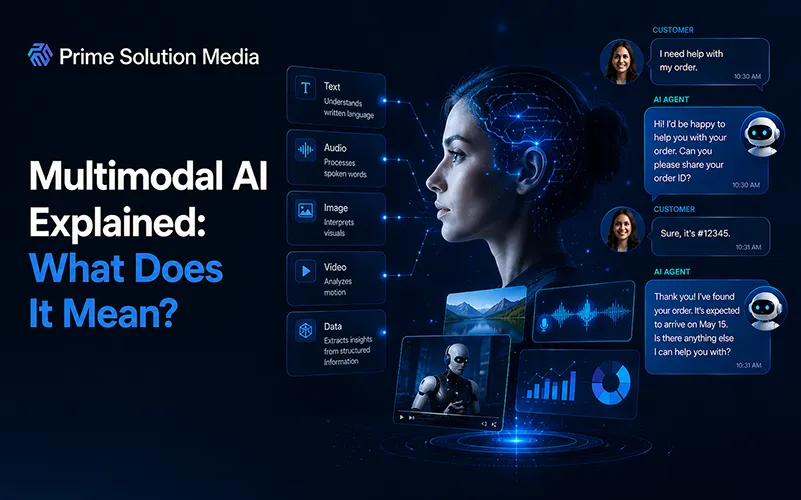
Multimodal AI processes text, images, and audio simultaneously to mimic human understanding. This technology helps businesses automate multi-format workflows, analyze complex documents, and save critical daily operational time.
If you’re hearing more about multimodal AI, it’s because businesses are moving beyond text-based tools and looking for AI that understands information the way people do.
In this guide, we’ll explain how it works, where it’s already being used, and why it matters for organizations planning their next AI investment.
What Is Multimodal AI and Why Is Everyone Talking About It?
Most traditional AI systems specialize in one type of data. A chatbot understands text, while an image recognition tool analyzes pictures. They perform their individual tasks well, but they don’t naturally combine different kinds of information.
Multimodal AI changes that. Instead of working with a single input, it processes text, images, audio, videos, and documents together. The result is a more complete understanding of the information it’s given.
Think about how people solve problems. If someone explains an issue while showing a screenshot, you’ll use both the explanation and the image before responding. AI is beginning to work in much the same way.
This is also the biggest difference in the discussion around multimodal AI vs. text only AI. Text-only models rely entirely on written prompts, while multimodal systems can use several inputs to provide richer and often more accurate responses.
As businesses create and manage more visual and audio content, AI that understands more than words is becoming increasingly valuable.
How Does Multimodal AI Work?
You might be wondering what happens behind the scenes when AI understands a photo, a voice recording, and a written prompt at the same time.
The process starts by converting every input into a format the AI can interpret. Whether it’s an image, spoken language, or a scanned document, the system analyzes each piece of information before connecting them to understand the overall context.
A key technology behind this is the vision language model. These models learn the relationship between visual content and human language, allowing AI to answer questions about charts, photographs, diagrams, handwritten notes, and other visual information.
In simple terms, how does multimodal AI work? It combines different sources of information instead of treating each one separately. That broader context helps AI identify patterns that might otherwise be missed.
For businesses, this means AI can review customer screenshots alongside support messages, analyze invoices with tables and signatures, or interpret inspection photos together with written reports. Those capabilities create a stronger foundation for faster decisions and better outcomes.
In the next section, we’ll look at some of the most practical multimodal AI examples and explore how this technology is already becoming part of everyday life.
Multimodal AI Examples You Already Use Every Day
Many people think multimodal AI is still experimental. In reality, it’s already part of products and services millions of people use every day. The biggest difference is that these tools no longer rely on text alone. They understand different types of information and connect them to answer questions more naturally.
Here are some common multimodal AI examples:
- Visual AI assistants that explain charts, diagrams, or screenshots.
- Customer support tools that review text, images, and voice notes together.
- Document analysis that reads scanned PDFs, invoices, and handwritten forms.
- Medical AI that assists healthcare professionals by analyzing images alongside patient records.
- Visual search that identifies products or objects from a photograph.
- Meeting assistants that combine audio transcripts with presentation slides to create summaries.
One well-known example is GPT -4 Vision multimodal, which allows users to upload an image and ask questions about what they’re seeing. Rather than treating the image as a separate file, the AI connects it with the conversation to provide a more useful response.
These growing multimodal AI applications show that AI is becoming better at understanding information the way people naturally share it, through a mix of words, visuals, and sound.
Multimodal AI for Business: Where It Creates the Most Value
Businesses don’t adopt technology simply because it’s new. They invest in tools that solve problems, improve customer experiences, or help teams work more efficiently. That’s why multimodal AI for business is gaining attention across industries.
Instead of switching between separate tools for text, images, and documents, organizations can use one AI system that understands all of them together. This saves time while providing more context for better decisions.
In fact, in OpenAI’s enterprise research, employees reported saving 40-60 minutes per day by using AI in their daily workflows.
Where Businesses Are Using Multimodal AI
- Customer support and help desks
- Sales and marketing teams
- Healthcare and diagnostics
- Manufacturing and quality inspections
- Retail and eCommerce
- Banking and financial services
- Logistics and supply chain management
Table 1: Business Uses of Multimodal AI
| Business Function | How Multimodal AI Helps | Example |
|---|---|---|
| Customer Support | Reviews screenshots, text, and voice messages together | Faster issue resolution |
| Marketing | Understands visuals alongside campaign data | Better content recommendations |
| Healthcare | Combines medical scans with patient information | Supports clinical decision-making |
| Manufacturing | Analyzes inspection images and maintenance reports | Identifies defects earlier |
| Finance | Reads invoices, receipts, and forms | Speeds up document processing |
Marketing teams, designers, and product managers are already using these capabilities to speed up parts of their daily workflow while keeping people in control of the final decisions.
Many organizations are also combining multimodal systems with AI automation to reduce repetitive manual work, whether that’s processing documents, handling customer requests, or organizing large amounts of business data.
Of course, multimodal AI isn’t always the right choice. In some situations, a traditional text-based model is still more than enough. Understanding that difference helps businesses choose the right solution for the job.
Multimodal AI vs Text-Only AI: What’s the Real Difference?
Text-based AI has become a valuable tool for writing, summarizing information, and answering questions. If your work mostly revolves around emails, reports, or articles, it may already do everything you need.
However, business problems don’t always come in the form of text. A customer might upload a screenshot instead of describing an issue. A technician may share inspection photos with maintenance notes. In these situations, text alone tells only part of the story.
That’s where multimodal AI vs. text-only AI becomes an important comparison. Rather than relying on written prompts alone, modern multimodal AI models understand different types of content at the same time, giving them a broader view of the situation.
Text-Only AI vs Multimodal AI
| Feature | Text-Only AI | Multimodal AI |
|---|---|---|
| Accepts Text | ✓ | ✓ |
| Understands Images | ✕ | ✓ |
| Processes Audio | ✕ | ✓ |
| Reads Complex Documents | Limited | ✓ |
| Analyzes Videos | ✕ | ✓ |
| Best For | Writing, summaries, research | Business workflows, customer support, visual analysis |
When Should You Choose Each?
Text-only AI works well for:
- Writing emails and reports
- Brainstorming ideas
- Content summarization
- Research assistance
- Translation
Multimodal AI is a better fit for:
- Reviewing product photos with customer feedback
- Understanding contracts that include tables and scanned pages
- Analyzing medical or inspection images
- Processing support tickets with screenshots and voice recordings
- Working with mixed formats in a single workflow
The goal isn’t to replace text-based AI. Instead, it’s about choosing technology that matches the way your business handles information every day.
How Prime Solution Media Helps Businesses Adopt AI with Confidence
Understanding AI is one thing; putting it to work effectively is another. Every business has different goals, workflows, and challenges, which is why the right approach matters.
At Prime Solution Media, we help businesses identify practical AI opportunities that fit their existing processes. From planning and implementation to system integration, our focus is on helping organizations adopt AI in ways that support long-term growth.
Our AI services include:
- AI consulting and implementation.
- Custom AI-powered solutions.
- Workflow automation and system integration.
- Business process improvement.
- Ongoing AI support and guidance.
Many businesses also ask about the difference between an AI agent vs AI chatbot. While chatbots are great for handling conversations and routine questions, AI agents can complete tasks, make decisions, and work across multiple systems. Choosing the right solution depends on your business needs.
It’s also becoming clear that generative AI is changing the economics of software development forever, making AI adoption more practical for businesses of all sizes.
Whether you’re exploring AI for the first time or building on existing systems, the right partner can help you move forward with clarity and confidence.
Conclusion
The way people interact with technology is changing, and AI is changing with it. Instead of working with text alone, multimodal AI can understand images, audio, documents, and other types of information together, making it more useful for solving real-world problems.
As businesses continue exploring smarter ways to work, understanding what is multimodal AI can help them make informed decisions about future AI investments. If you’re considering how AI could fit into your business, Prime Solution Media can help you identify practical opportunities and build solutions that align with your goals.
Frequently Asked Questions
What is multimodal AI in simple terms?
Multimodal AI is an advanced computer system that processes and combines text, images, audio, and video simultaneously to understand information much like a human does.
What is the main difference between multimodal AI and text-only AI?
Traditional text AI relies strictly on written prompts, whereas multimodal AI integrates diverse inputs like screenshots, voice notes, and scanned documents for much richer responses.
How does multimodal AI benefit business operations?
Multimodal AI streamlines business workflows by analyzing mixed formats simultaneously, saving individual employees forty to sixty minutes every single day through unified operational data context.
When should a business choose multimodal AI over text-only AI?
Choose multimodal AI when your regular workflows involve mixed media, such as analyzing medical scans, processing invoices with tables, or reviewing customer support visual screenshots.
What is the difference between an AI agent and an AI chatbot?
Chatbots excel at text conversations and routine answers, while advanced AI agents can autonomously make decisions, execute tasks, and operate across multiple business software systems.




