
Key Takeaways
- Agentic AI focuses on completing goals, not just responding to prompts.
- It supports complex business workflows across multiple departments.
- Enterprise adoption is growing as AI systems become more capable.
- Success depends on combining AI with clear governance and human oversight.
This blog explains agentic AI, autonomous systems that plan, make decisions, and complete multi-step enterprise workflows, highlighting its business use cases, operational benefits, and collaborative future alongside human oversight.
Businesses have spent years asking AI to answer questions, write content, or summarize reports. Now, the conversation has shifted. Companies want AI that can actually complete work, not just respond to prompts. That simple change explains what is agentic AI and why it has become one of the biggest topics in enterprise technology.
Whether you’re leading a business, managing IT, or exploring AI adoption, understanding this shift matters. In this guide, we’ll explain what agentic AI means, how it differs from traditional AI, why enterprises are investing in it, and where it is already making a difference.
What Is Agentic AI, Really?
The easiest way to understand agentic AI is to think beyond chatbots.
Most AI tools today wait for instructions. They answer a question, generate a report, or write an email. Once the task is complete, they stop.
Agentic AI works differently. Instead of waiting for every prompt, it focuses on completing a goal.
What Does Agentic AI Mean?
So, what does agentic AI mean?
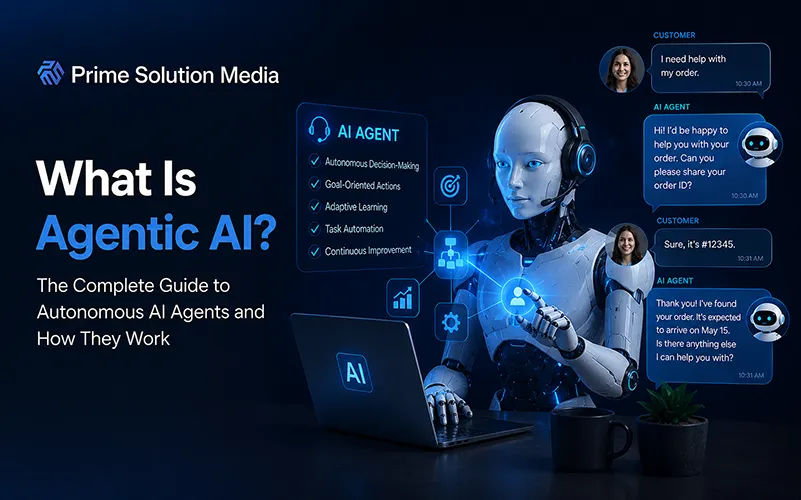
It refers to AI systems that can plan, make decisions, complete multiple connected tasks, and adjust their actions while working toward a defined objective. Rather than treating every request as a separate job, these systems understand the bigger picture.
For example, instead of simply drafting a customer response, an agentic system could review the customer’s history, create a support ticket, notify the right department, and schedule a follow-up without someone guiding each step.
This ability comes from what is known as agentic behavior in AI. The system evaluates information as work progresses and decides what should happen next while still following business rules and human oversight.
Common characteristics include:
- Working toward defined goals.
- Planning several steps ahead.
- Adjusting when new information appears.
- Using data from different systems.
- Asking for approval when required.
| Traditional AI | Agentic AI |
|---|---|
| Waits for prompts | Works toward goals |
| Handles one task | Completes connected tasks |
| Needs frequent input | Requires less supervision |
| Produces outputs | Delivers outcomes |
Agentic AI vs Traditional AI: What’s the Difference?
At first, both technologies may look similar. They use artificial intelligence, process information, and generate results. However, they solve problems in very different ways. ways.
Traditional AI Responds, Agentic AI Acts
The simplest way to understand agentic AI vs traditional AI is this.
- Traditional AI responds to instructions.
- Agentic AI works toward an objective.
Suppose a customer submits a support request.
A traditional chatbot answers the question. An agentic system may answer the customer, create a ticket, assign it to the correct team, monitor progress, and send updates until the issue is resolved.
That ability to coordinate several actions is why agentic AI explained often focuses on outcomes rather than responses.
| Feature | Traditional AI | Agentic AI |
|---|---|---|
| Decision making | Limited | Context aware |
| Workflow | Single task | Multi-step process |
| Human involvement | Frequent | Reduced |
| Goal | Generate answers | Complete work |
That growing need is driving enterprise interest.
Why Are Enterprises Investing in Agentic AI?
Every business has repetitive work. Customer requests arrive every minute. Reports need updating. Teams wait for approvals. Information moves between departments all day.
Traditional automation has certainly helped. However, many workflows still stop whenever a decision is needed.
That is exactly where agentic AI for enterprise is attracting attention.
Solving Business Problems Beyond Automation
Instead of following a fixed sequence, agentic AI can evaluate information and decide what should happen next within approved limits. In fact, 64% of organizations say AI is already driving innovation, reinforcing the value of intelligent systems that can support more complex business workflows.
Businesses are already using it to:
- Prioritize customer support requests.
- Schedule meetings automatically.
- Monitor inventory levels.
- Assist finance teams with recurring reports.
- Coordinate project updates.
- Route requests between departments.
- Review data before escalating unusual cases.
As a result, employees spend less time managing repetitive processes and more time solving problems that require experience and judgment.
Another advantage is flexibility.
Traditional AI workflow automation often depends on predefined rules. If something unexpected happens, someone usually has to restart the process manually.
Agentic systems can often adapt without interrupting the workflow. That also improves AI workflow optimization, especially in environments where priorities change throughout the day.
Many organizations are also exploring autonomous AI agents for enterprise models. Instead of relying on one AI system, they use several specialized agents that work together. One gathers information; another analyzes it, while another communicates with employees or customers.
This approach makes AI automation more practical because each agent handles a specific responsibility while contributing to a shared objective.
Of course, technology only becomes valuable when it solves real business problems. So, where are companies already putting agentic AI to work? That’s where the conversation becomes even more interesting.
Real-World Agentic AI Examples and Use Cases
The idea of AI completing work on its own can sound futuristic. In reality, many businesses are already testing or using agentic systems in day-to-day operations.
The goal is not to replace people. It is to reduce repetitive work so teams can focus on decisions that require human judgment.
Where Businesses Are Already Using It
Here are some practical agentic AI examples across different departments:
- Customer support: Resolve common requests, create tickets, and follow up automatically.
- Sales: Qualify leads, schedule meetings, and update CRM records.
- IT operations: Detect system issues, create incident reports, and notify the right teams.
- Marketing: Coordinate campaigns, track performance, and prepare reports.
- Finance: Process invoices, flag unusual transactions, and generate recurring reports.
- HR: Manage onboarding tasks, collect required documents, and schedule training sessions.
| Business Function | Example Use Case |
|---|---|
| Customer Service | Ticket handling and follow-ups |
| Sales | Lead qualification and scheduling |
| Finance | Invoice processing and reporting |
| HR | Employee onboarding |
| IT | Incident monitoring and response |
Can Smaller Businesses Benefit Too?
Large enterprises often make the headlines, but this technology is becoming more accessible every year.
Growing interest in small business AI adoption means smaller teams can also use AI agents to handle repetitive work, improve response times, and keep projects moving without adding more administrative effort.
The key is to start with one workflow that consumes valuable time and measure the results before expanding to other areas.
Is Agentic AI the Future of Enterprise AI?
No technology solves every problem, and agentic AI is no exception. Businesses still need clear goals, quality data, and human oversight to use it responsibly.
Even so, the direction is becoming easier to see.
Looking toward agentic AI in 2026, more organizations are expected to use multiple AI agents that collaborate across departments instead of relying on isolated automation tools. Better integrations, stronger governance, and improved security will also make enterprise adoption more practical.
Rather than replacing employees, agentic AI is likely to become another member of the team, handling routine work while people focus on planning, creativity, and critical decisions.
How Prime Solution Media Helps Businesses Prepare for AI Adoption
Understanding agentic AI is only the beginning. Putting it to work requires a clear plan that matches your business goals.
At Prime Solution Media, we help businesses identify where AI can provide measurable value without adding unnecessary complexity. We work with organizations to improve digital processes, identify automation opportunities, and build AI-driven solutions that fit existing operations.
Whether you’re exploring AI for the first time or looking to expand current initiatives, our team can help you move forward with confidence.
Conclusion
Agentic AI is changing the conversation around artificial intelligence because it moves beyond generating answers and begins completing meaningful work.
As businesses continue exploring what agentic AI is, the real opportunity lies in understanding where these systems add value and where human judgment should remain part of the process.
While the technology is still evolving, its direction is becoming clearer. Organizations that take the time to learn how agentic AI works, evaluate practical use cases, and introduce it thoughtfully will be in a stronger position to adapt as enterprise AI continues to grow.
Like any business technology, long-term success depends less on adopting the latest trend and more on applying it where it genuinely solves real problems.
Frequently Asked Questions
What is agentic AI and how does it work?
Agentic AI refers to independent systems that plan, make decisions, and execute multi-step workflows to achieve specific business goals rather than just answering simple prompts.
What is the difference between agentic AI and traditional AI?
Traditional AI simply responds to isolated user prompts, while agentic AI proactively automates complex, connected workflows to deliver meaningful business outcomes with minimal human supervision.
How does agentic AI for enterprise improve daily business operations?
It automates repetitive tasks across departments like HR, finance, and customer service, enabling multiple specialized autonomous agents to collaborate, adapt, and optimize complex operational workflows.
Can small businesses benefit from adopting autonomous AI agents?
Yes, small business AI adoption allows smaller teams to automate tedious administrative work, accelerate customer response times, and scale operations efficiently without increasing overhead costs.
What does the future look like for agentic AI in 2026?
Enterprises will increasingly deploy multiple collaborative AI agents across departments, relying on stronger governance, robust security, and human oversight to achieve maximum seamless workflow optimization.




2 Comments